Saturday, October 15, 2022

Peter Robinson, RIP

This is a blog written in surprise, sadness and mild shock, certainly not a blog that I thought about prior to writing. As is my habit, I begin my mornings by glancing at the headlines of the International Guardian web-page: there may be an article or two that grabs my interest. Before leaving, I check the obituaries page, in case there might be an article about someone who interests me.

Today it was first Robbie Coltrane, the Scottish giant. I'm not sure where I first saw him and recognised him for who he is; I have just discovered that he appeared in two Bond films, one of which ('Goldeneye') I'm quite fond of. It certainly wasn't Hagrid, the role that probably he will be most remembered for. He also appeared in the video for Kate Bush's song, "Deeper understanding", that I've seen a few times in the Bush renaissance.

Then I saw Peter Robinson's name on the obituaries page. Robinson writes/wrote the DCI Banks series of novels that I've written about many times. Normally there is a new Banks book most summers, but this year and last year there was nothing. Covid-19, I told myself. Now I discover that Robinson completed another Banks novel, "Standing in the shadows", that is to be published next year.

Robinson died "suddenly after a brief illness"; this is obviously a euphemism,  although for what I do not know. The same is written on his web site, that reveals that Robinson actually died nearly two weeks ago, on 4 October. I was going to write about the coincidence of Robinson dying the same day that Ian Rankin publishes what is guaranteed to be the last Rebus novel (although he could always write about the young Rebus).

Peter Robinson was an immensely talented writer over a very wide range, from poetry, to short stories, noir thrillers to more literary works. He was in fact Dr Robinson, with a PhD in literature, and we saw glimpses of that, and sometimes his poetry, in his novels – as well of course of his very eclectic love of music, shared by Banks. His novels are superbly plotted (one reviewer said he had the precision of Swiss watchmaker) and the settings are vivid and fully real, but it’s the richness and depth of his characters that keep the readers – including me – coming back for more.  [Thus writes Carolyn Mays, who was Peter Robinson's editor]

I am greatly saddened by this news.

Friday, October 14, 2022

Gillian McPherson

This afternoon I conducted one of those aimless Internet searches, where I started with one obscure folk singer, then by a series of links ended up with a name that I haven't seen for about 50 years - Gillian McPherson.

I remember seeing her at the Bristol University Students' Union in March or April 1971: she appeared solo, of that I am certain. I think that she was the third act of three, but I have no idea who the headliner might have been, and presumably the reason why I had gone to this concert. I was moderately impressed by her performance, especially by one song, "Look what we've got to do". It must have been shortly after that a favourable review of her (apparently only) record, "Poets and painters and performers of blues" appeared in Melody Maker, so off I went to the record shop to buy this.

On record, Gillian was far from unaccompanied: some tracks had strings arranged by Robert Kirby (very much the flavour of the time after his work with Nick Drake) and some tracks had backing by Tommy Eyre (producer?), Jon Mark (?) and Johnny Almond, who were three quarters of the group 'Mark Almond' that I liked at the time. "Look what we've got to do" received a good arrangement and production, and I recall that I used to play this song myself - it had the decending G6 F#7 FMaj7 E chord run that I like.

I have another hazy memory of Gillian: either I went to see her at a concert a bit later but she cancelled, or someone else cancelled and she played. It's a shame that I threw away my 'concert log' several years ago. Anyway Gillian disappeared and she hasn't crossed my mind since. The entire album can be found here.

Information about the album or the singer seems scarce; from one source, I see that she apparently was born in Belfast, 1949; this explains the background behind the song "They all want somebody to blame", a waltz that I remember (now) being introduced as about "the troubles", ie Belfast. It also means that she was only 22/3 when I saw her.

What are the songs like? An awkward mixture, it sounds to me now. "Is somebody in tune with my song" has a string arrangement far better than the song itself. "Who's at the deceiving end?" is sung archly - maybe an attempt at a single. The afore-mentioned "Look what we've got to do" and "We can't be the last line" have good arrangements and performances; no doubt these are the songs that attracted me. "Flight" features a complex guitar (Jon Mark?) and cello arrangement, again far better than the song warrants; a bit too precious for me. "Lazy dreamer" is jaunty and probably wouldn't have found favour with the soon-to-be 15 year old; I don't care for it now. The title track (the final song) features clumsy drums.

I get the feeling that I was less impressed with the record than with the performance, which is probably another reason why I haven't thought about these songs for 50 years.

Tuesday, October 11, 2022

Another DBA update

As I wrote only two days ago, I'm not going to continue working on the thesis until I receive my supervisor's feedback. Yeah, right (that's how two positives can make a negative). That blog entry was posted at 16:40; I took the dog for a long walk and think, and when I came back, I had more ideas for the thesis. Yesterday I worked another three hours on the thesis, and today I worked another two. As far as I can see, the thesis is now complete, except for the following:

  1. More interviews for the main case study which should lead to the presentation of more data [whilst writing this blog, one of the intended interviewees has asked me to call tomorrow]
  2. Presentation of data for the second case study
  3. Presentation of data for the third case study - this will be easy.
That's it! On the basis of the first case study, I created a 14 point model (as noted in that previous blog). I then compared the processes of the second and third case studies to this model, and enlarged it slightly, to 16 points. I also retroactively analysed the the enhancement used in the pilot study; the model showed where and why I (and the CEO) consider it to be a failure: the first part of 'continue managerial and technical support' didn't happen.

Yesterday afternoon, I took the final, conclusions, chapter of the previous thesis and plunked it down at the end of the current thesis. I then went through it with a very blunt editorial knife, cutting out everything that seemed not relevant to the current thesis. This morning, I went over this chapter again with a much sharper knife, cutting out more sentences that no longer made any sense. I then had to repopulate parts of the chapter with new material. It may not be the final version, but it's definitely a step in the right direction.

As I've noted above, one of the intended interviewees sent me a message whilst I was writing the previous paragraph, so I'll interview her tomorrow, and hopefully I'll have more data to add. This interview will be recorded on the telephone, so it's less likely that the problems that dogged the first interview will return (that interview was via Teams, with video).


Sunday, October 09, 2022

DBA update

This is the religious holiday period in Israel where it seems that we work one day, have two days off, work another day, have more days off, etc. Being an office worker means that officially I don't work on the mornings prior to a festival (Jewish festivals start in the evening: tonight is the first night of 'The festival of booths', so today is very similar to a Friday. Officially I don't work in the morning, although I did connect for an hour and a half), meaning that I have several stretches of no work. I have been using that time diligently.

Last week I interviewed our external consultant; our talk lasted about 35 minutes. Obviously there is no way that I am going to transcribe this, so I sent the recording off to the company that transcribes my interviews. After I sent it, I noticed that I had received the transcript of the first interview. Armed with an abundance of time and two interviews, along with my own self-interview, I started work again on the thesis.

The first thing that I did - that took a few days, an hour or two at a time - was to reread the thesis from the beginning. Here and there I added sentences or changed the phrasing. I was specifically looking for sentences that referred to the previous examined version of the thesis that was multi-company; such sentences had to be either emended or removed. Once I had done that, I applied the advice from my supervisor from six months ago: he said that I was mixing up the data from the case studies with the discussion of those studies. 

I had been thinking about this as well, so a big change structually was to chop chapter 7 - the case studies - into two. Remaining in chapter 7 is the presentation of each case study followed by what might be termed the meta-data, namely the time-line of the enhancement being studied and data about the interviews. This is part and parcel of the Action Reseach paradigm. The new chapter 8 will eventually consist of four or five sections: a miniscule introduction, one section each for the three case studies and possibly one concluding section (this might possibly become a chapter in its own right). Each case study section will then again consist of three sections: data, discussion and conclusions (is there a synonym for 'conclusions' that begins with the letter 'd'? 'Deduction' isn't right, and 'denouement' is too fancy, although it's possible).

Once I did this, I then considered how to display the data for the case studies; after all, I'm discussing the data but the data hasn't been shown. I thought of a tabular display, where each row displays a question and in each column appears the interviewees' remarks. After working on this for a bit, I realised that it was not practical as in most cases, the answers were more or less the same. So I converted this table into a new one; each row is still one question, but there is only one 'responses' column, where the text is prefaced by either [All], showing that everyone said the same, or [NN] (or whatever) when one person had a specific point to make that wasn't covered in the general remarks. This caused me to move some material from the discussion section into the data section.

I was working towards the concluding questions when I wanted to include a quote or two from the first, transcribed, interview. I couldn't find the appropriate questions and answers, so I played the recording, hoping to find the answers there. Nothing. The recording 'said' that it was 26 minutes long, but there is nothing recorded after 16 minutes - very annoying, very strange. I noted this fact in the meta-data section.

I then wrote a letter to the transcribing company, pointing out that the price I was quoted was based on a 26 minute long interview, but in fact it only lasted 16 minutes and so I should have been charged less. Also there were words missing in the transcript (there are a few examples where it is written 'the - ', so the transcriber was aware that words were missing); to make things worse, the transcription was referenced with line numbers (e.g. the 10th line of an answer) which is totally useless for my purposes. I need time stamps, when a question begins and when the corresponding answer begins. This way I can easily check the recording when the transcript seems unclear. I don't know when I'll get a reply to this letter - probably only in a week or so.

I sent this version off to my supervisor, asking whether this format of data was suitable. I had intended to take some time off from the thesis, but after taking the dog for a long walk, I was back at work, created the conclusions section for the first case study. This is the really important section: it's where I present my analysis of the process followed in developing and deploying the enhancement, along with any improvements that I or the interviewees think is necessary. This is going to form the process or model for the successful development and deployment of enhancements in Priority, which aside from being a mouthful, is also the central issue of my thesis.

Four years ago I had a seven stage framework for the successful d&d; this was something that I had dreamed up and I wanted to see how real-world d&d matched this framework. One major criticism of the first examined version of the thesis was that I had things backwards: instead of proposing the framework then seeing how this worked in practice, I should have examined real-life examples then derived from them the process. 

This is what I have done now: the process that I 'extracted' from the case study has 14 (!) different stages and it might be that another one or two are  required. One can be stated as 'enlist user support' (or 'create perceived user value'); I don't want to check this at the moment, because (a) I'm writing this blog and don't want to get side-tracked, (b) I think that tactically it would be better if this stage came from the discussion of the third case study, which was an example of failure, specifically for this reason (there was no user enlistment, but plenty of user resistance). I should also apply these stages to the pilot study.

I'm not going to continue working on the thesis until I receive my supervisor's feedback, but I am trying my hardest to conduct two more interviews that I badly need/want for the first case study.


When I am not working on the thesis, I am reading a fascinating book called "The code breaker: Jennifer Doudna, Gene Editing, and the Future of the Human Race" by Walter Isaacson. To quote part of the blurb, "The bestselling author of Leonardo da Vinci and Steve Jobs returns with a "compelling" (The Washington Post) account of how Nobel Prize winner Jennifer Doudna and her colleagues launched a revolution that will allow us to cure diseases, fend off viruses, and have healthier babies". By chance, today I discovered that Doudna and her main colleague won the Nobel Prize for Chemistry two years ago for this work - I haven't got that far in the book yet. I have the impression that there will be a chapter or two about working with Covid-19, but I don't want to get ahead of myself yet.

I find the book fascinating, but there's one thing that niggles slightly. In this book and others similar to it, it often reads as if one waves a magic wand and achieves a doctorate. The following snippet is an example: "[Barrangou] enrolled at North Carolina State in Raleigh and got his master’s degree in the science of pickle and sauerkraut fermentation. He went on to get his doctorate there, married a food scientist he met in class ...". There doesn't seem to be a hint of the struggle that I've had. On the other hand, all these doctorates have been achieved by people working full-time in a university laboratory, normally with defined experiments to carry out. I'm not sure about early doctorates in computer science: I get the impression that once it was enough to pick a topic and write a program about that topic. I used to have a copy of someone's doctoral dissertation about writing a Prolog interpreter in C. I doubt very much that I still have this, as it would make interesting reading. When I found it - probably at the end of the 1980s - I knew much less about Prolog and doctorates than I do now.

Thursday, October 06, 2022

Weight and bp confirmed

I went to the clinic today, primarily to receive a flu innoculation (they had run out) but also to check my weight and blood pressure, to see if there is any significant difference between what I am measuring at home and what is measured at the clinic.

The blood pressure is slightly better than what I have been measuring, so I am somewhat reassured. But my weight is ± 85.5 kg, meaning that I have indeed added over 3 kg to my weight over the summer. The nurse was not particularly impressed and didn't suggest that I see a doctor about this.

I am taking matters into my own hands: I stopped eating rice biscuits at the beginning of the week after a television dietician said that these do not cause weight loss. I have gone back to my old habit of slicing a yellow bell pepper and eating the slices throughout the day. I am considering making changes in my oat cookies, replacing the jam, raisins and chocolate buttons with peanut butter; obviously this is going to change the taste, but also hopefully reduce the number of calories in each cookie. Finally I started this morning to eat bread without butter; whilst this affects the taste of the bread, it should again reduce the number of calories. Obviously I don't expect to see any difference this week, but hopefully next week's weighing will show an improvement.

Saturday, October 01, 2022

The 2022 swimming season finishes

Excuse the poor selfie: this was an attempt to capture myself in my dressing gown next to the pool, prior to my entering it for the final swim of the year. 

In 3½ months of visiting the pool, apparently I have swum 567 lengths, or just over 14 km. I thought that after a shaky start, I swam 20 lengths every Friday and Saturday, but it seems that I didn't do so in June and some of July. I swim at a pace of about 1 length per minute, but the entire process lasts just over an hour (walking to the pool, swimming, resting, walking home then showering). So I'll have two more hours a week at my disposal.

With all this swimming and also walking (almost every day over 10,000 steps, which is about 8.5 km), one would think that my weight has decreased. Somehow, since the first of June, my weight has ballooned from 81.8 kg to 85.1 kg! That is not very encouraging.

Last week was the vernal equinox and the Jewish New Year; the nights have been getting longer and cooler. Despite this, the days have been very hot, reaching 35-37°C at midday. Something else has changed as well: along with the heat, I've started having headaches that range from the mild to the annoying - minor migraines. The first time I was taken unaware and had a miserable day; since then I've taken two half pills, but I'd prefer not to have to take anything at all.

I'll close off  this portion of the blog with a long quote from the book "Blue mind":
But there’s much more to the experience of swimming than buoyancy. Water has a tangible quality, a weight, and it has 600 times the resistance of air. Unlike earth or air, we can explore water in multiple dimensions — up, down, sideways; as neurologist Oliver Sacks comments, we feel tangibly supported and embraced by this “thick, transparent medium.” The resistance and pressure of water contribute to swimming’s role as one of the best forms of both aerobic exercise and muscle toning. Because the pressure of water outside the body is greater than the pressure inside, explains Bruce E. Becker, director of the National Aquatics and Sports Medicine Institute at Washington State University, water forces blood away from the extremities and toward the heart and lungs. The heart responds by upping its effort, pushing this extra volume of blood more efficiently with each heartbeat, and thus circulating upwards of 30 percent more blood volume than normal throughout the body. To cope with this increased load, the arterial blood vessels relax and create less resistance to blood flow. 

Here’s the intriguing part: one of the hormones that regulates arterial function is catecholamine, and catecholamines are part of the body’s response to stress. As Becker describes it, “During immersion, the body sends out a signal to alter the balance of catecholamines in a manner that is similar to the balance found during relaxation or meditation.” In other words, just being in the water can create a feeling of relaxation and a decrease in stress.  

But that’s not all. The lungs are receiving a greater volume of blood as well, which, combined with the pressure that water exerts on the chest wall, makes them work harder to breathe — approximately 60 percent harder than on land. This means that aquatic exercise can strengthen the respiratory muscles and improve their efficiency. In one study that compared aquatic aerobics with “dry” aerobics, Becker discovered that while various forms of aerobics improved fitness levels and some respiratory capacity, only aquatic exercise improved respiratory endurance. The muscles, too, are benefiting from the increased circulation as they receive greater amounts of blood and oxygen. And it’s a good thing, too, because it requires effort to propel the body through water; in swimming, every muscle is benefiting from what is essentially resistance training (one of the best ways to increase both tone and strength). In addition, swimming works the large, smooth muscles of the body, stretching and lengthening the muscles, joints, and ligaments with each stroke, while the head and spine get a good workout with every breath you take. It all means that stroking through the water not only puts you into a psychologically relaxed state, but also makes you physically stronger.  

Like other forms of aerobic exercise, swimming can produce the release of endorphins and endocannabinoids  (the brain’s natural cannabis-like substances), which reduce the brain’s response to stress and anxiety. Some theorize that the feel-good effects of swimming are related to the same “relaxation response” triggered by activities like hatha yoga. In swimming, the muscles are constantly stretching and relaxing in a rhythmic manner, and this movement is accompanied by deep, rhythmic breathing, all of which help to put swimmers into a quasi-meditative state.

(Nichols, Wallace J., "Blue Mind: How Water Makes You Happier, More Connected and Better at What You Do" (pp. 108-110). Little, Brown Book Group. Kindle Edition. )

I don't know about that quasi-meditative state. I do know that I find it easier to swim when I am thinking about anything but swimming; for example, last week I was working out the algorithm for improving the correlation calculations, and the lengths went by swiftly. But the day before, ironically I was thinking about perseverance and how it applies to swimming; I had slight problems in maintaining rhythm. I have overcome this in the past via the use of headphones, but I have become very dissatisfied with them: when I manage to get them to work, my ears get blocked so I can't hear anything anyway.

There appears to be a solution for this: one day, I was talking with a swimmer older than I, and I could hear something emanating from around his head. He explained that he gets very bored when swimming (aha! I'm not the only one) and so he found headphones that work by bone conduction. After walking home, showering and decompressing, I went looking for such headphones on the Internet and ordered a pair. Obviously they were not going to arrive in time for this year's swimming, but I'll have them for next year. They'll also be useful when walking the dog in rainy weather: I should be easily able to fit those headphone on my head then put on a woolly cap and possibly a waterproof-cover.

As Wikipedia puts it, Bone conduction is the conduction of sound to the inner ear primarily through the bones of the skull, allowing the hearer to perceive audio content without blocking the ear canal. Bone conduction transmission occurs constantly as sound waves vibrate bone, specifically the bones in the skull, although it is hard for the average individual to distinguish sound being conveyed through the bone as opposed to the sound being conveyed through the air via the ear canal. Intentional transmission of sound through bone can be used with individuals with normal hearing — as with bone-conduction headphones — or as a treatment option for certain types of hearing impairment. Bone generally conveys lower-frequency sounds better than higher frequency sounds. 

I didn't know about the frequency filter until reading this now; this is a bit disappointing but I suppose that it's not that important in the long run. I wonder whether I should listen to songs with vocals or instrumentals; I think that songs will help me keep more focused on the music and less on the swimming, which is the whole point. 8 GB storage is huge! I calculate that I swam for about 9½ hours for the entire period this year, which means that fully loading the storage will cause no song will repeat. I'll write more about this once the headphones arrive and I start using them. Ironically, the wiki article doesn't mention the possibility of using bone conduction headphones when swimming.

Tuesday, September 27, 2022

More statistical analysis

I wrote a few days ago about performing statistical analysis on a cohort of slightly more than 600 people who have taken the OP's flagship exam twice, concluding with the words [I used] a very painstaking method which is also v-e-r-y slow. One reason for this lack of speed was a query that was opened once for each person, that would retrieve the score for a given scale from both exams at the same time. I thought previously that this would be faster than opening a more naive query twice for each person, in which the score for the first exam would be retrieved, followed by the score for the second exam. The number of times that the sophisticated query (with a few self joins) would be opened is the number of people times the number of scales measured. The naive query gets opened twice that number.

At some stage, I decided to allow the user to choose for which scale/s the calculations would be calculated, instead of iterating over all the scales (about 40). This certainly made the debugging easier!

I knew that one of the problems with my standard code for calculating means and standard deviations is that there are people who have values for the first exam for a given scale but not for the same scale in the second exam, which is why I was using this 'painstaking method'. I then suspected that a sophisticated query (that included a check that there were values for the same person for the same scale in both exams) might be doing more than it needs to be doing. So I split the work into two: first there is a query that returns for everybody the value from the first exam for a given scale (this is already faster), then for each person the value from the second exam is retrieved. The calculations are based only on those who have a value for the second exam. This made a great improvement in the time for any given scale, even when everybody who had a value for the first exam had a value for the second. But this was small change (a double entendre).

The biggest time saver came from the way that I was accessing the database. Both the z-test (comparison of two means) and correlation are parametric tests, in that they depend on means and standard deviations. So I could calculate the values once for every scale then use them for these tests, both of which are dependent on the difference between a given value and the mean (e.g. the mean score for a given scale is 31.2; the difference between a person's score and this mean is required). The standard deviation is based on the square of the difference between a score and the mean, whereas correlation is dependent on the difference in one test multiplied by the difference in the second test.

My standard SQL code for calculating the mean can be done in a single query, but I couldn't use this method. So I was retrieving the score for each person, calculating the mean, then retrieving the score again and subtracting this from the mean in order to calculate the difference. Why was I hitting the database again to retrieve the data that I had already retrieved? I wrote some simple code to store the retrieved score in an array; further manipulations would be performed on the array instead of accessing the database a second time. The only problem with this is declaring in advance the size of the array; I chosed 1000 elements, allowing 40% spare room at the moment.

This simple change caused a huge speed-up! I had been using a progress bar to show the progress of retrieving values; this now worked so fast that the progress bar didn't have time to update. 0 to 100 in a second! So I dropped this progress bar as it was only adding overhead.

Now that the calculation for a scale works very fast, it was time to look at the results. The z-values for the scales were all very low, showing that there was basically no difference in the means of the two exams, or in other words, the exam itself was valid. But the correlations led to a slightly different conclusion; most had values between 0.60 and 0.75, meaning a strong correlation, but not as strong as the z-values. One scale had a correlation factor of only 0.31, which is considered a weak correlation. Both the means and standard deviations for this scale were nearly the same, so I asked myself from where was coming the difference.

I looked at the raw data: apart from 3 people whose score changed greatly between the exams, most people had near enough the same scores. In some cases, the score was slightly higher in the first exam and in other cases, it was slightly higher in the second exam (there were also a few cases with the same score in both exams). This explains why the correlation factor was so low: a high factor would mean that everybody's score improved, but because some 'improved' and some 'regressed', not everybody is in step and so the factor is low. As far as I am concerned, the z-test is more appopriate than correlation, in this case.

As I wrote to the OP, it's not as if there were a group of people who took an exam with well-defined answers, got their marked paper back, worked on their wrong answers, then took the exam again. One would expect everybody's score to improve, albeit by different degrees; the correlation factor would be a mathematical way of expressing 'by different degrees'. But here there are no correct answers but rather a measure of how they feel at the time that they took the exam. 

Now that I think about it even more, this does make some sense: the problematic scale supposedly measures people's attitude towards communality. One would expect that the attitude of people who had a 'poor COVID-19 experience' (especially if they were hospitalised) to communality would have worsened when 'after' is compared to 'before', as opposed to those who had  a more positive experience to the pandemic (e.g. myself) might be expected to increase with regard to communality.

Sunday, September 25, 2022

Two films

I watched two films on TV today; in both cases, I saw about 75% of each film, missing the beginning. There were similarities between the films: both were set in Seattle, one completely and one partially. Both featured widowed fathers to 10 year old boys; both had love interests who were involved to one extent or another with another man.

One film probably had a low budget; no actor was familiar to me. The other film probably had quite a high budget, with a name director and six name actors, all well known. One film had an almost totally believable story whereas the second had a totally unbelievable story. One film probably had low pretensions and came off quite well, whereas the other had high pretensions and I don't understand how people can rate this film so well.

One was 'Sleepless in Seattle'; the other was 'Hint of love'. One film you've all probably heard of, the other is completely unknown. I leave you to draw your own conclusions about which film was more successful.

Saturday, September 24, 2022

New Year greetings

As I wrote six years ago, by chance, it happens that the evening of the new Jewish year [will] fall on Sunday night; as a result, most people have a very long weekend - from Friday until Tuesday inclusive (or if you prefer, my last working day was on Thursday 22/9 and my next working day will be on Wednesday 28/9).

I've got a few bits and pieces to do for the daily job and for my consultancies; I also want to devote several hours to my doctoral thesis, and as a result, I hope that I don't have too many idle hours.

Yesterday and today I worked several hours for the OP; yesterday had some more clever ideas for the 'ERP' program, and today I worked on a statistical analysis program, calculating both z-values and correlations for people who have taken our flagship exam twice. Is there much difference between the two exams? The z-values don't show anything statistically interesting, but the correlations for some scales aren't very high. Due to the fact that some people took the exam twice but don't have values for all the scales both times (because we added some scales at a later date), I couldn't use my usual code for calculating means and standard differences. I had to use a very painstaking method which is also v-e-r-y slow.

Monday, September 19, 2022

I held an interview!

I see that I last wrote about my doctoral research in January, a long, long time ago. I had just come to the realisation "that I had a huge enhancement taking place underneath my nose" and so made structural changes to the thesis in preparation for researching this enhancement (the warehouse management system, aka WMS). I didn't realise at the time how long it would take for the WMS to reach a stage where I could interview people about it.

It took a few months for us to upgrade our ERP system successfully (upgrading the standard system wasn't a problem, but we have a few external programs that are essential to how we work and these had to be modified to work with the new version); then we discovered that the database manager (i.e. SQL Server) had to be updated; then we had problems with the wireless network and the program that prints labels .....

I won't go into all the problems that we faced, but basically we only started working with the system in the middle of August, which was at least three months later than I had expected. I had been looking at the calendar with a worried expression on my face, as I have until the end of December to complete the research, write it up, reach conclusions and then finally submit the thesis.

About a week ago, I could see that the system had reached a state suitable for people to talk about it, even if it isn't 100% finished, and so I sent out letters to the four people that I intend to interview. Three answered affirmatively, although two have yet to agree on a date. The fourth person, the man who is running the WMS on the factory floor, hasn't answered yet, which is a shame, as I am very interested to hear what he has to say.

Today I interviewed the factory manager, who normally strikes me as distant and apathetic, but the interview was actually very good, and lasted for nearly 30 minutes. After I had asked all my questions, one more interesting question occurred to me: did the manager think that the long delay and slow pace of implementing the system was a help or a hindrance? I, for example, think that my slow pace in recording songs is actually beneficial as I get the time to consider and reflect on the songs before they are finished*. We agreed that the long time was beneficial, although it could have been shortened somewhat.

After completing the interview and finding the recording via Teams, I realised that there was no way that I was going to transcribe the interview. The pilot study from last year found that it took me about ten minutes to transcribe one minute of interview, so I was looking at nearly five hours work. I then started looking for the company that had transcribed some of the pilot interviews; at first I couldn't find anything (it didn't help that I started by looking in the wrong place), but eventually I found the receipt that I had scanned and from there got back in touch with the company and uploaded the file.

I wonder how long it's going to take for me to get the transcript returned: next week is the Jewish New Year which means several days off work. Then it will be Yom Kippur and following that another week or more off work. This is a double-edged sword: whilst I have time off work, the transcribers also have time off work which might well delay the return of the transcripts. I had looked forward to using the time on my hands to advance the thesis greatly; I suppose that I can listen to the interview(s) without having the transcript(s) and work on that basis.


(*) I have been working on the music for a new song over the past few weeks. No words, of course, and no idea about what the song is going to be about. Every couple of days I think that I have completed the music, but then I listen to it again and have some more ideas. So definitely I need time for contemplation and reflection on music.

Sunday, September 11, 2022

The Ink Black Heart/2

Rereading the book slowly is interesting, especially the online conversations between the moderators (one has to read the book to know what I'm writing about). I picked up several hints that I missed the first time around, because I had no idea what they were talking about.

And in the course of doing so, I've discovered a major mistake by the author in chapter 23, that consists entirely of online conversations. A very important turning point in the book (almost at the end) is that two characters never take part in the same conversation. Well, I'm sorry to say that those two characters do take part in the same conversation at least once. Oops.

On the other hand, Robin and Cormoran don't see these conversations .....

Tuesday, September 06, 2022

The Ink Black Heart

At the beginning of August, I received an email stating that the sixth book in the Strike series would be published at the end of the month (i.e. a few days ago). I wouldn't say that the anticipation was huge and that I couldn't fall asleep at night wondering about the book, but I did reread a few of the earlier books in the series and waited patiently until the end of the month.

I've just spent a few days slogging though the new book which is extremely long, apparently more than 1,000 pages in its printed version. Although the previous book, "Troubled blood", was also long, it was also attention keeping, whereas I had problems giving sufficient attention to TIBH. Woven throughout the book are transcriptions of online chats, and whilst most of these are important to the story, there are too many and too confusing (especially at the beginning). The language - and the abbreviations - used gave me problems. Maybe this is how the youth speak (or more accurately, write) these days. There were several terms/abbreviations that I had to look up on the Internet in order to understand them.

What makes the book long is the multiple storylines: apart from the online chats and the actual story line (who killed the creator of TIBH online cartoon), the book also tells about other cases that the agency is handling, about Strike's love-life (in every book he seems to get a new love - or at least, sex - interest), the never-ending will they/won't they Robin/Strike dynamic, along with bits and pieces from Robin's own life (now that she's divorced, other possibilities arise). Some of this, especially the bits connected with Strike's old flame, Charlotte, could easily have been removed.

It wasn't until the book was about half way over that it began to be interesting. I will, of course, reread the book, hopefully getting more out of it the second time.

Another take on the book can be found here: whilst I agree with most of the review, I don't particularly agree with the paragraph that begins And there is a problem with Cormoran Strike himself. He’s rude, violent and doesn’t understand women He certainly isn't ruder than any of the younger participants, I don't remember him being violent (or at least, not unnecessarily so) and I think that he is more misunderstood by women than he misunderstands them. [I should point out that this was the first review that I came upon, so it may not be representative of other reviews. I'm not trying to make a point on the basis of this review.]

One slightly strange (to me) aspect of the book is that it is set in 2015 and so continues the time-line from the earlier books. Was YouTube such a big thing in 2015? Were the abbreviations current? The setting seems more modern that this, although I appreciate that one can't have a five year gap in the story lines of two consecutive books without something to explain what happened in those five years. Actually, as opposed to the other books, there are very few references to the detective agency's previous cases, as opposed to events in the protagonists' private lives. But Robin turns 30 (and Strike 40) in the book, whereas a previous book told about her 29th birthday

Monday, September 05, 2022

Hard boiled eggs

My wife likes to eat hard boiled eggs (*). Instead of cooking them in a small saucepan with a lid, she cooks them in what's known here as a finjan, a small open pot that is normally used for making coffee in the oriental style. I pointed out to her that a great deal of heat is lost when the water boils, as it escapes as steam; it would be more efficient to put a lid on the pot to catch the steam.

But the finjan doesn't have a lid, so I would often balance a small plate on top of the finjan. Recently I did this, but the plate didn't balance and the pot fell to the floor, splashing me with boiling water. I treated the scald immediately (it hurt for about an hour), but I have been left with a red patch above my right knee that one day might fade away.

As a result of this misadventure, I resolved to find a better way of boiling eggs. I suggested the saucepan route, but it seems that we don't have a small enough saucepan; also, I believe that the boiling water causes cavitation that can break an egg's shell. I went looking on the internet for an alternative and found the device pictured above (it was on the website of an Israeli (?) gadgets site; my wife wanted something from there, and I continued looking to see what else they might have). 

I ordered the gadget (about 150 NIS, which these days is equivalent to maybe $40) and it arrived after two weeks. Unfortunately there was no explanation whatsoever as to how to use it (excluding the Mandarin written on the box). Viewing this as an intelligence test, instead of puzzling out how to use the gadget (and in fact, how to put it together), I took the alternative route and looked on the internet for a manual. I got many hits for the gadget but far fewer for instructions; eventually I found some and downloaded them. These aren't 100% accurate for my gadget (they seem to be for a slightly different model) but good enough for my purposes.

First one removes the clear perspex dome and the white egg caddy (pink in the picture). Using the tiny cup that comes with the gadget, one fills it with water (this is maybe one teaspoon-full, i.e. 15 ml) then pours the water onto the steel plate that is revealed under the caddy. One then replaces the caddy, places however many eggs are required (I think that six can be done at once) then replaces the dome. Finally one turns on the electricity.

There is a heater under the steel plate: this causes the water to turn to steam, thus cooking the eggs. Indeed, after about ten seconds the plastic dome was covered inside with condensing steam. After about 7 minutes, the gadget turned itself off - there is presumably some device like a thermostat that recognises when all the water has been turned to steam. I unplugged the gadget from the wall socket but let the eggs set there for a few more minutes as they cooked.

Despite the fact that there is no boiling water to create air bubbles that might break an egg's shell, one of the eggs that I cooked this morning had the tell-tale 'albumin bubble', presumably caused by the shell cracking slightly and the white of the egg leaking slightly. 

This gadget seems to be far safer and more efficient than boiling water on a stove.


* I used to like eating hard boiled eggs but now they seem to have a metallic taste. In the summer of 1972 and 1973/4, during the many field trips that I took in Israel, we used to have boiled eggs every day for breakfast. Someone would get a fire going (or we had gas rings), then we would fill a big pot (we used to call them 'tillys') with water and place eggs inside to be cooked. I had an unofficial competition going with our leader in 1972 as to who could peel an egg with the fewest pieces of shell. After some practice, I was able to peel an egg with only two pieces of shell, which I thought was the fewest number possible, but one day I peeled an egg leaving the shell intact! This was possible because directly underneath the shell there is a membrane to which the shell sticks; if one doesn't puncture the membrance, one can peel the egg leaving all the shell stuck to the membrane.


In 1979, whilst working in the kitchen in Mishmar David, one of my fellow cooks would make hard boiled eggs for breakfast. For this we used what is apparently called a 'steam kettle', similar to the one shown in the picture on the left. Every kibbutz kitchen had several of these in different sizes - on Mishmar David we had two really big ones, three smaller ones and one really small. We would put the eggs in a wire basket then put the basket in the smallest kettle in order to cook. The eggs that my fellow cook would make were far from hard boiled - they were so soft that I used to say that she showed the kettle to the eggs, then took them out to the dining room to be served.

Saturday, August 20, 2022

Oat biscuits

Someone suggested that eating oats might be beneficial to me, where oats have a high fiber content and a reasonably low potassium content. At first, the only way that I thought that oats might be consumed is via porridge, and that's not really an option on the summer. Then I considered oat biscuits, and when I saw how easy (and cheap) it would be to make my own, I started looking at recipes.

I admit that I'm not a baker: in my years of cooking prior to 1980, I had never baked a cake. I started baking cakes when I was in the army so that I would have something to eat on weekend guard-duty, but these were hardly high cuisine cakes, and I stopped immediately after I left the army. Baking requires more exact quantities than my usual play-it-by-eye style of cooking, which is a good reason why I don't bother. But it seems that oat biscuits are more forgiving.

The first recipe that I tried had a large amount of flour (as well as oats, of course) and some butter. This recipe annoyed me because the quantities were in cups as opposed to metric units. I made the mix, placed quantities on the tray, put the tray in the oven and waited 10 minutes. I checked a biscuit and it seemed too soft, so I baked for another 10 minutes; again, the result was too soft, so I baked for yet another 10 minutes, then took the tray out of the oven. The biscuits were very big, so I cut them in half then froze them. The results were so-so.

The second recipe that I tried also has quantities in cups, which is suprising as it is an Israeli recipe. I made some substitutions in the ingredients and the results (after 15 minutes baking) were reasonably good. So I repeated this recipe yesterday afternoon and baked a new batch.

Steps:
Break an egg into the mixing bowl and whisk it. Add a quarter of a cup of canola oil and mix. Then add the following dry ingredients: one cup of oats, one table spoonful of flour (I used spelt flour), one table spoonful of blackcurrant jam (providing sweetness and flavour), two table spoonfuls of apple puree and a handful of sultanas. Mix everything together, then using the spoon, place quantities on an oven tray covered with paper. The above quantity makes 11-13 biscuits. Bake in the oven for 10-15 minutes at 180°C (I turned the heat off after 10 minutes; I don't know how much the oven cools down in five minutes, but I can save on electricity).

The biscuits look ok but I haven't tasted one of this batch yet. As there are no preservatives used, I put them in the freezer and each day take out a few.

Thursday, August 04, 2022

My first year at Bristol Grammar School (1967-8), along with memories of sports

Once upon a time, until about 1965, there used to be something called the 'eleven plus': a compulsory exam that all children would sit prior to finishing primary school (aged 11). Those that passed this exam would go to 'good' schools, whereas those that didn't would go to 'other' schools. Around 1965, this exam was abolished, or at least the compulsory part of it was. It became retitled to something like 'the grammar school entrance exam'; those who chose to sit the exam and passed went to what were then the direct grant grammar schools, good schools. Those who failed the exam or chose not to bother automatically went to comprehensive schools. No doubt these terms are explained at Wikipedia but I'm not going to bother and look them up.

As I have probably written elsewhere, I sat this exam and did so well that I won a free scholarship to Bristol Grammar School (BGS) - this meant that I (or my parents) didn't have to pay any fees to the school. Other possibilities were a partial scholarship, presumably paying reduced fees, and a place - full fee paying. I've been trying to remember what the exams were about: there was definitely one on arithmetic. There might have been one on general knowledge and one on "English", presumably comprehension, although we might have had to write a story. I do remember the room in which the exam was held - I don't think that I set foot in this room once in all the six years that I was at BGS. There were two other direct grant schools for boys in Bristol (there were four for girls), but these seemed to have Christian connections whereas BGS was agnostic, so I wasn't interested in going to them.

During the summer holidays of 1967, I was informed as to which house I was to join. This is a tradition that comes from boarding schools, where the boarders physically lived in their house, along with their house-master. All the direct grant schools were day schools, but the tradition lived on. It was mainly for competitive purposes, i.e. games. We had to wear a tie every day: it could be either the school tie or the house tie - my house was called Trott's (after Mr Trott) and our colour was green. So I had a green tie and green topped socks.

I can remember the names of most of my teachers from the first year (confusingly called the 'thirds'): Mr Firth taught science, Mr Leaver Latin, Mr Williams maths (and choir), Mr Dehn French and Mr Patton English and physical education. Presumably we also were taught history and geography, but these were subjects that did not appeal to me. I have a strong memory of an early science lesson: Mr Firth asked what a curve in the surface of a molecular substance is called when it touches another material (e.g. water in a test-tube). Three boys (including me) put their hands up; the first boy was called and gave the wrong answer. The second boy also gave the wrong answer. Then it was my turn: "meniscus" I answered; Mr Firth walked towards me and I seriously thought that he was going to hit me (not that this was permissable) for giving an obviously wrong answer. Instead he made a tick mark on my jacket sleeve with chalk: I had given the correct answer (I was good at general knowledge). At the end of the year, I achieved three As in the annual exams: in science, Latin and slightly surprisingly in maths. These was my best marks in all my years at BGS.

I also have a memory of going to my father's office, which was about half a mile from the school, near the Cabot tower. We had homework to write out declensions of Latin verbs, so I sat there, writing amo amas amat amamus amatis amant, like schoolboys throughout the ages. That late afternoon was sufficient to fix the declension in my mind for a few years (and I still remember it, although everything else is hazy). I may remember very little Latin, but what I learnt in those lessons greatly helped me when I started learning Hebrew.

I have no idea on what basis we were divided between the six houses, but the boys in my year and house (with whom I was to spend a great deal of non-academic time) were pretty good at sports. For the first two terms we played rugby and I think that we won the 'championship', played between all six houses. We definitely won the cricket 'championship'; in fact we won it four times out of the six years that I was at the school.

I gave up rugby as soon as I could, 'playing' it only in the winter term from my second year onwards. Being small and rotund afforded me no advantages and the frequent rain didn't help. From the second year I played hockey in the spring term and became quite good at it. I was in the school hockey team for a few years, playing right wing, but unfortunately we didn't win a single game in all those we played against other schools. I missed what would have been our final game (presumably in April 1972) as I had just had inoculations (tetanus?) prior to travelling to Israel in the summer of 1972 (April seems very early, now that I think of it), and my replacement scored the goal that won the game! In my final year at school, I played inside right for the school's second XI, which was much more fun. I actually scored a goal or two and we won most of our matches. We also beat the Old Bristolians' hockey club (featuring Fred Wedlock), a feat that apparently had never occurred before or since.

My house came very close to winning the school hockey championship that year (1973). A friend (in the first XI) and I built the team from those in our house who we knew played hockey, along with a few rugby players who were sufficiently athletic to make a contribution. We won our first game or two; the final was an exceedingly close match (which nearly came to blows at one stage when one of the rugby players on the other side made a somewhat physical tackle, or similar) and in fact ended in a draw, 1-1 (IIRC). The game, though, was decided in favour of our opponents as they had had more 'corners'. I found this very hard to believe as I was the corner-taker for our team and there was a period when I took three or four corners in a row. I think that I was almost in tears at the end.

We had one very good swimmer in our year (he was something of a late developer and stayed an extra year to become head boy) and presumably one or two other reasonably good swimmers. I was asked to swim a length of backstroke for the medley, and I agreed, on the minor condition that I be awarded 'swimming colours' at the end of the year, regardless of how well I swam. I also picked up cricket and hockey 'colours' at the end of the year so I could be seen to be quite good at sports.

We won the cricket championship that year, although my contribution in the final was minimal. For some reason the captain sidelined me all the time (although I suppose that I wasn't so good). I seem to remember holding a catch when fielding slip, but what happened was that the ball came towards me and ran up my sleeve, getting caught in my armpit. I certainly didn't catch it with my hands.

I also represented the school, on and off,  playing cricket at various ages. Sometimes I would be in, sometimes out. I have a memory of being about 14 and going in last: I managed to defend my wicket long enough for my partner to make some runs. The master in charge was so impressed that he had me batting number three (i.e. a specialist batsman) in the next game; I was out first ball and probably out of the team for a couple of games. I became a scorer, sometimes for my age group and sometimes for the higher level teams.

At some stage I also played for the school's second XI when I was young; they were short one person and I must have been available (scorer?). This is where I met three young gentlemen who were two years older than me but very kind to me in the following years, when I was probably an obnoxious twerp. In my last year I very much wanted to play in the second XI but was deemed not good enough; I was offered the opportunity of captaining what was then a non-existent third XI, but I was sufficiently hurt to turn this offer down.

In June 1972,  I was telephoned one day at home and asked if I wanted to play a game of cricket for the Old Bristolians second XI (the OBs were sports teams made of graduates from the school). I would love to. Here I got the chance to bowl a bit (one wicket) and made a catch. I don't remember what number I was batting - might it be three again? - but this time I deserved the position. I got off to a rather sticky start: at one end of the ground, the sun was right behind the bowler's arm so I couldn't see the ball when it left his hand and came towards me. There was an appeal for LBW that was turned down (although I think that the umpire later told me that I should have been out and that he left me in for sporting reasons). After this, the going got a bit easier ... and easier ... and eventually I scored 60 runs, a huge score. By the end I was running out of partners and was having to 'steal the strike' quite often. I was also quite tired and half deliberately got out by hitting a ball in the air to a fielder who caught it. Game over.

Then I had the most momentous summer of my life until then (Israel 1972) and completely forgot about this game, until a few months later when someone said that they had also played for the OB 2nd XI (or similar) and had leafed through the score book, where they were very surprised to see the details of my innings.

Wednesday, August 03, 2022

My life as multiples of 11

Today is my 66th birthday - that's 6 times 11.

I emigrated when I was barely aged 22 - 2 X 11 - and so I have lived 44 years (4 X 11) in Israel. Of those 44 years, for 11 years I lived on Kibbutz Mishmar David, and for 33 years (3 X 11) I have lived on Kibbutz Tzora.

Prior to my emigration, I lived 11 years in Bristol and 11 years elsewhere.

Of course, this situation occurs every 11 years.

Saturday, July 30, 2022

Kate Bush - a little harmonic analysis

First of all, unless I am mistaken, today is Kate's 64th birthday. 64 is a great number: 82, which is 44, which is 28. A very round and palindromic number. Happy birthday!

But I'm not writing numerical analysis and not sending birthday greetings. Instead I want to give a little harmonic analysis of a few of Kate's songs. My interest was picqued by the several analysis videos that I've seen on YouTube about 'Running up that hill', each coming from a different angle. What is clear is that the song is composed entirely of three chords: in roman numeral analysis, i bVI bVII (the song is in C minor, so these chords are Cm, Ab and Bb).

Although this isn't world shattering, this did start me thinking about the chord sequences in Kate's songs - or rather, the lack of conventional sequences. This reminded me of why I was originally attracted to Kate's songs - they are unpredictable and mainly defy analysis. The prime example might be the opening to 'Wuthering Heights', the original (in more ways than one) song that introduced me and thousands of others to KB. The first phrase repeated twice consists of the chords A F E C#. Apart from the fact that these are all major chords, they don't belong to any one key. Whilst E is the dominant of A, there is no key that contains the A, F and C# chords. F is the submediant of A (the flattened sixth, to be accurate) and C# is the mediant of A (the diatonic chord would be C# minor). One could say that this is a series of chromatic mediants - A to F, E to C#, C# to A. As a result of all this, Kate Bush is one of the few artists whose songs I don't automatically analyse in my head.

I started thinking about other KB songs that have the i bVI bVII sequence and two songs came to mind. The first song on the first KB album, 'Moving' starts off with this sequence but afterwards continues in a more diatonic path. The first song on 'The sensual world' (alternatively called 'The sensual world' or 'Flower of the mountain' depending on which version is being played) has a variation on this: I VII VI VII repeated throughout the song, although it might be that the fourth chord (VII) is really v (i.e. the minor dominant chord).

Today I was plunking around on the piano when it suddenly occurred to me that 'Cloudbusting', a song from the same album as 'Running up that hill' has exactly the same chord sequence (i VII VI) although I don't know in which key (I have relative pitch, not absolute pitch). But the two songs are so different in every aspect that one would never reach this conclusion easily.

[Addition from several months later] It was pointed out to me that the opening song on the second side of the album, 'And dream of sheep', starts with exactly the same chord sequence as 'Cloudbusting', even in the same key, C# minor.

Saturday, July 09, 2022

One year since my father died

It's exactly one Gregorian calendar year since my father ז"ל died (the Hebrew anniversary is in a few weeks), so I thought that I would write something in his memory. Looking at the blogs from a year ago, I see that there was no preparation: boom, he died. That's not how it happened.

My mother ז"ל died in 2002; this was quite a surprise. She had been hospitalised a few days beforehand, but there was talk of discharging her when overnight all the systems in her body collapsed. At least her actual death was peaceful. My father had never been alone since having met my mother in 1952, so we were quite worried about how he would manage. To our surprise, he coped quite well, suddenly discovering a modest talent for cooking (in my childhood, there was a running joke that all he could cook was burnt toast). In 2012, we even celebrated his 90th birthday in a restaurant in Tel Aviv.

About a year later, he suffered from a minor urinary infection, which to a young person would have been negligible, but apparently such infections in the elderly cause a scrambling of the brain. We took him to a gerontologist in Jerusalem where he was asked basic questions like what day of the week is it, what year are we in, and who is the prime minister of Israel. Whilst getting the third question wrong would be understandable, he failed the other questions; his mental condition was much worse than I had suspected.

Even before this, we had been given 'points' from the National Insurance that covered the cost of a few hours a day of help; a woman would come from Bet Shemesh, clean his flat, cook some meals, and talk with him. But after the gerontologist, it became clear that he shouldn't be left alone, and so we received permission from the Ministry of the Interior to employ a foreign worker, or in the colloquial, 'have a Philipina'. We also got more points from the NI, but a full time worker meant that her salary had to be supplemented; fortunately my father's pension easily covered this.

I've noticed that when people are forced to get around by golf cart, they cease walking; a similar phenomenon happened when the Philipina arrived: my father did less and less, retreating into himself. Still, she would bring him to us for lunch every Saturday, we would visit here and there, and he even was photographed with his first great-grandchild. 

Sometime in 2019, I noticed that he basically was in a world of his own. People used to ask me how he was, and using my terms of reference, I would say that he is like a computer that is plugged in but lacks a screen and keyboard: his body was working but he couldn't communicate with us, nor us with him. I requested our family doctor to look at him: her verdict that physically he was ok and not suffering from anything that could be treated. The nurses would check on him once a month to see that there was no deterioration.

The first year of Covid-19 was problematic, as his regular Philipina had gone home for a holiday in February 2020 and was due back in mid-March, which was the day the airport closed (so she didn't return then). We were fortunate to find a replacement, someone who might be termed a free agent who was also somewhat illegal, in that she wasn't funded by the NI. This carer was actually much better than the regular one; on the one hand, we wanted her to continue, but on the other hand, she was costing us a great deal of money, and one day the regular carer would manage to return. This state of affairs lasted for about five months. One major suggestion of the free agent was to place my father in a mechanical bed that could be raised and lowered as need be; we got the bed from Yad Sara, an organisation that provides and/or loans medical equipment for the home.

Vaccinations for Covid-19 became available at the end of 2020. At first, the Philipina didn't want to be vaccinated: we had to talk to her several times about this. We very much wanted my father to be vaccinated, more as a precaution, as the chances of him catching the virus were minimal - except via the Philipina. Although her age (the same as my daughter) would have made her ineligible for vaccination, people in her position were vaccinated along with the people that they looked after. So somehow I got my father into a wheelchair and took him to Bet Shemesh; here we faced a problem: how to explain to him that he was about to be vaccinated for a virus that had caused a great deal of disruption in the previous year? Of course, there was no way, so he reacted physically (and probably cried out) when the needle went in. Fortunately, the vaccinations were over extremely quickly. There were no side effects, and three weeks later we repeated the procedure.

It wasn't until one Friday night in June when the Philipina phoned me as we were having dinner: she was very worried about my father. After a few minutes of indecision, I decided to go and see how he was, which was exceedingly not good. He was undergoing contortions and every few minutes would stop breathing (completely unlike sleep apnea). I called the on-call medic (there is always someone on the kibbutz who can handle emergencies, primarily heart failure) but he quickly saw that there was nothing that he could do.

So we called an ambulance that arrived several minutes later; the ambulance men checked him out and said that there was nothing that they could do either, so we had a midnight ride to Hadassa hospital (part of the route is on a cliff edge, so driving this fast at night is somewhat frightening). In the emergency room, he didn't appear to receive much treatment. The doctor noticed that he had a fever, so he was given antibiotics and probably paracetamol via infusion; after an hour or so, he became more relaxed. I think that I took him for a CT to see whether there was any internal cranial bleeding (there was none). At about 3 am, we were taken somewhere else in the hospital (I got a bit lost) and he was placed in a room by himself. A resident came in to check him then told us to rest. The Philipina sat in the comfy chair and I laid down on a mini-sofa to sleep. I awoke a few hours later and went in search of some medical personnel; a nurse checked my father out, just to make sure that he was still with us. He probably changed the infusion as well.

Fortunately I had money in my wallet (a rare occurrence) so I was able to find a taxi that would take home. I slept for a few hours then with my wife went back to the hospital; here I swapped placed with the Philipina who my wife drove home so that she could rest for a few hours, shower, change clothes and eat. As it was Saturday, all the shops and cafes in the hospital were closed. 

For the next twelve days, I would get up in the morning, do a little work, eat breakfast, then pick up the Philipina and drive to the hospital - she's still working and is required to accompany her charge when in hospital. Sometime between 3 and 4 pm we would return home. She would help the nursing staff (she actually is a nurse herself, although I was not particularly impressed by her skills) and I would interface with the medical staff. I had noticed that my father wasn't capable of closing his mouth, and aligned with the loss of ability to move his left arm, it appeared that he had suffered a minor stroke.

I was told that a speech therapist would come and evaluate his capability; as there were only two speech therapists for the entire hospital, it wouldn't be until the following Sunday (i.e. after eight days of hospitalisation) that he was seen. One day a nutritionist came; one of her questions was how tall my father was. I told her that he was bit shorter than me, but that he had shrunk so I wasn't sure how tall he was now. She saw that the Philipina was feeding him Ensure (which we had bought) and said that the hospital would provide this - but in all the time that we were there, I never saw the hospital provide a can of Ensure. 

The day after the visit of the speech therapist, I accompanied my father to the bowels of the hospital where he was to have a feeding tube ('zonda') inserted. This turned out to be a much harder procedure than anticipated, primarily because his head had shrunk, and the angle from the mouth into the oesophagus was sharper than normal. I was told to provide an infusion stand and a pump that feeds the zonda: one gets such a machine from Yad Sara, so that day after finishing our hospital stint, I drove to the main YS warehouse in Jerusalem in order to get the equipment. Unlink the mechanical bed and other items, one has to pay 4 NIS a day for the zonda pump. 

The next day, I took the equipment up to the ward where I requested someone to show us how to use it. In the mean time, a doctor had informed me that whilst checking the placement of the zonda, they had seen (presumably by x-ray) that there was liquid in my father's lungs. Presumably he had aspirated something, but because he was continually lying down and his weakness, he was unable to clear this liquid. 

Once I heard this, I knew that the end was close. This was on Tuesday, so I was only mildly surprised to receive a phone call from the hospital at about 1 am on the Friday to say that my father was on the way out, and that I should come to the hospital to say goodbye. I replied that I had been in the hospital all day and had already said my farewells, and that artificially maintaining his life so that I could come and see him die was not something that I wanted. My wife concurred.

I tried to go back to sleep after this but it was impossible, which is why my first blog on the topic was posted at 3:40 am. A few hours later, we went to the hospital and up to the ward, where I was given his belongings - the clothes that he had been wearing when he was hospitalised. I'm not sure whether the zonda pump was in his room or whether I had taken this home a day or so previously. A doctor and a nurse tried to explain and comfort me, but I told them that it was fine, that his death was not a surprise and that he was no longer suffering (nor I). We then went home and sat with the Philipina; she reacted more visibly than I did, having looked upon my father as the grandfather that she never knew. The carers are well-known for the empathic bond that they make with their charges, and often at funerals, these people break down crying, whereas everyone else tries to hold their emotions.

The blogs that I wrote in the immediate aftermath of my father's death seem emotionless to me now. It's not that I wasn't feeling anything; it's more that this was an event that I had been anticipating for a few years, and its eventual happening was a release that was more welcome than saddening. I had lost my father several years before he died, and whilst now I wish that I had spent a little more time with him, I know that I did spend the time when it meant something.

The middle portion of David Lodge's "Deaf sentence" is very similar to my experience.

Friday, July 01, 2022

Kate Bush (once again)

Seemingly like everyone else on the planet, I've been undergoing a renewed interest in Kate Bush. This started a few months ago whilst listening to 'Before the dawn', the multiple-cd set of recordings from her performances in 2015 that sold out within 15 minutes. This can roughly be divided into three parts: unconnected songs, the 'ninth wave' suite from 'The hounds of love', and the 'Sky of honey' suite from 'Aerial'. As it happens, originally I wasn't too enamoured with the ninth wave and sky of honey suites when I first heard them.

Somehow, these live versions seemed much more palatable than the original versions; after listening to the live versions, I decided to go back to the original studio versions, which now do find favour in these quarters.

During the month of June 2022, Kate's star has risen once again, with one of her songs being featured in a Netflix series. Now all sorts of Youtube videos are rising to the top; today I came across a most fascinating document - a collection of appearances on BBC TV, recorded in the day. The first few appearances feature performances that are not the well-known recorded versions, although these are not live! One can hear Kate harmonising with herself here and there, tending to imply that no one is playing live. I saw on one song ('This woman's work') a miscue in the miming, not that this is too important. 'Wuthering Heights' - where it all started - is a completely new version: new arrangement (although very close to the original) and possibly live vocal. I notice that Kate's hand movements during the chorus must have been fixed at an early stage as these are consistent over all the performances that I have seen. I have never seen any of these performances before, primarily because I emigrated in 1978 when Kate's career was taking off, and no one in Israel had heard of her then (we also didn't really have television station(s) either, then).

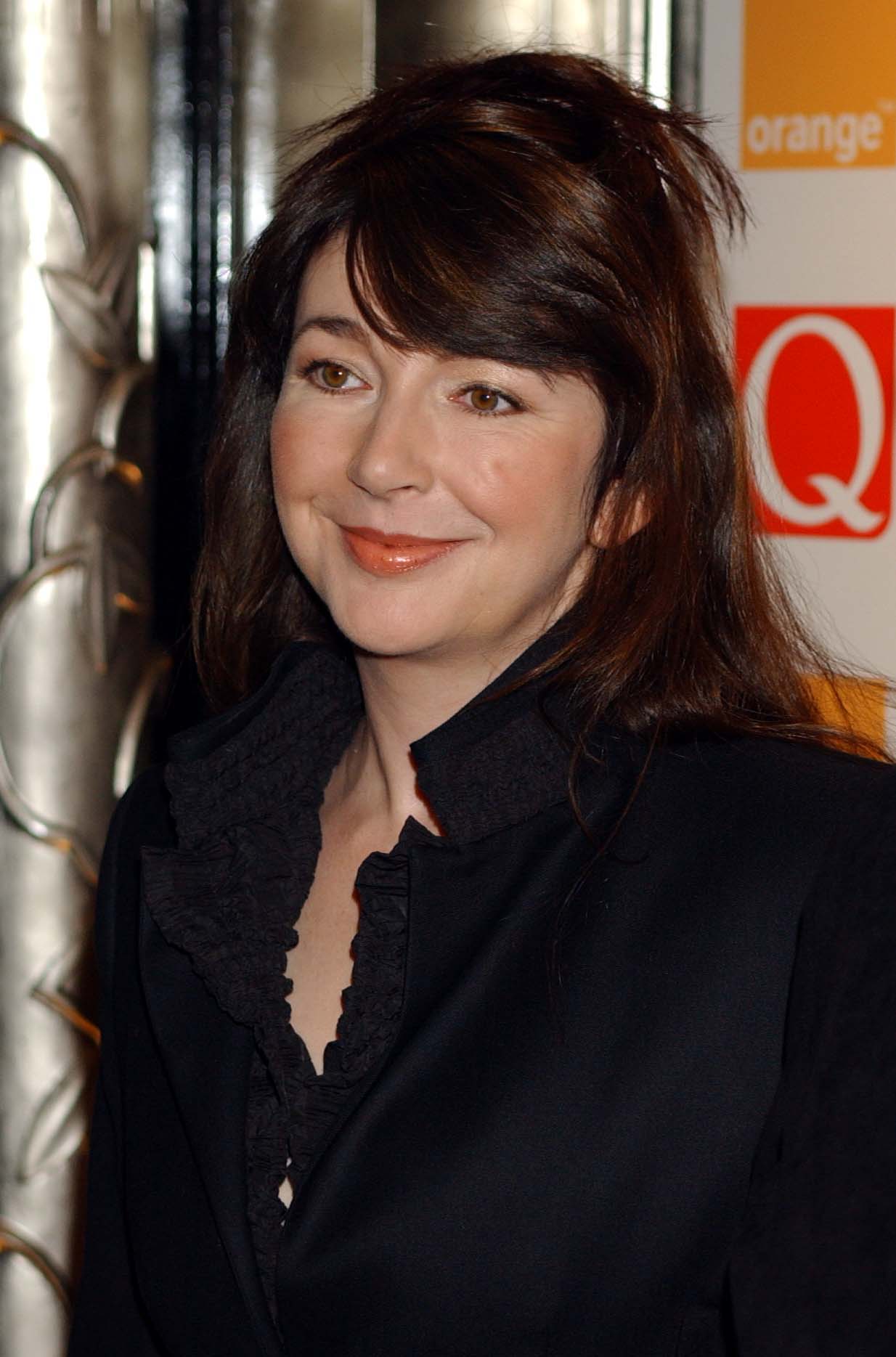
Kate is almost exactly two years younger than me (her birthday is four days before mine) so I know automatically how old she is in every video. It's interesting to see how she has aged: initially, she looks much older than she really was (I remember looking at the photo on her first album and thinking 'oh, this is what she looks like, maybe in her mid-20s' - she was 19!), but later on she takes on a more mature appearance. Unfortunately the most recent pictures of her show a great deal of middle age spread, a feature normally reserved for males who drink.

I am including Kate's version of 'My lagan love' in my folk songs talk - her version has the same immaculate song sung unaccompanied, but with new lyrics by her brother. I will wear my Sandy Denny t-shirt.