Saturday, June 24, 2017

Bumpers

Following my attempts at finding songs which I loved as a youth, I turned my attention to the third Island Records sampler, 'Bumpers', which was released towards the end of 1970. Almost all of the acts who appeared on 'Nice enough to eat' returned to this album, but as several acts had spawned offspring, Island now had enough acts to fill a double album. I was familiar with most of the groups who appeared here, but there were some curiosities which I enjoyed but never followed up on (probably because of budgetary reasons although also as these groups didn't perform in Bristol and I was turning towards folk music).

Whilst researching this blog entry, I came across someone else's blog which covers the entire double album, giving a certain amount of information about every track along with lyrics. There wasn't much information which was new to me, but it's always interesting to read another take on the same record. The collected lyrics are worthy. I remember that the Blodwyn Pig track had a different vocal mix to the one found on its parent album; this factoid is not mentioned.

The first song which I tracked down is "Island", by Renaissance; it quite amused me at the time that they had a song referencing their record company. This group also recorded a song called 'The sea', which possesses the same name as a song by Sandy Denny on the contemporary Fotheringay album: two different songs with the same name. I was able to find the entire album as well as various histories of this group: after their eponymous debut album from which this song is taken, the group split and the name laid dormant for a year or so until another line-up formed and eventually became quite successful. I've been listening on and off to the album over the past few weeks but can't say that I find it compelling.

The other track which caught my interest was "Reaching out on all sides" by jazz-rock group If. The riff of this song stuck in my memory and I often used to play it in order to check the tuning of my guitar. It took me many years to realise that the riff is in 7/4 time. Youtube has the entire album available; again, after listening to it on and off for some weeks, this opening track is the only one which I like to hear. This is a masterpiece of dynamics: maintaining the 7/4 rhythm throughout, the arrangement moves though various sections, highlighting different instruments in the group.

The Bumpers blog contains the following description of the song (which is attributed to Jim Newsom; I read it elsewhere on the Internet but can't find the original at the moment): The song opens quietly, a lone guitar playing a gentle, bluesy intro that becomes a repeating riff in 7/4 time. Hodkinson's vocal arrives, with the first couple of verses accompanied only by the electric guitar floating atop barely audible organ chords. The saxophones appear playing a complementary pattern as the bass guitar and drums sneak into the mix. The song builds for a couple of minutes, the odd-metered rhythm becoming more insistent. Then the guitarist's riff turns into a sizzling two-minute solo flight over smoldering organ, bass and drums. When the horns reemerge to resume their earlier pattern, vocalist Hodkinson returns to take the song to its lyrical climax. Saxophones, organ and guitar build to a climax, until guitarist Smith is left alone for the denouement. I especially like the short passage between the second and third verses.

So, in retrospect, it's just as well that I didn't follow up on these songs then as I wouldn't have enjoyed their parent albums.

Bonus material: I was listening to 'Reaching out on all sides' whilst writing this. When it finished, Youtube then played a song called 'Listen' by Chicago. I have no recollection whatsoever of ever having heard this song, although I do recall that someone at my youth club had a copy of their first album (when they were still called 'Chicago Transit Authority'). The bass line of this song is identical to the tune of a very early song of mine, which was never written down. Did I 'quote' this bass line? I have no idea.

Saturday, June 17, 2017

Business rules with functions (2)

I wrote a few months ago about an undocumented way to write complex business rules in Priority. Whilst I was copy editing my thesis again this morning, finding a few errors, I had a minor epiphany when reading the section about form triggers. I have always believed that it is not possible to write a business rule which compares two fields in the form (e.g. display an error message when the production date of a customer order is greater than the date that the customer wants to receive the order) and so have always handled such cases with a trigger.

This morning it occurred to me that it is possible to write a business rule which will compare two fields. In my previous blog, I showed an example which can be read as "Display an error message if the value in the 'towarhsname' field differs from the expression (:$.TOWARHSNAME IN ('23', '999') ? :$.TOWARHSNAME : '!!!'). Ignoring the technical aspects of this, I was using the same variable name in the expression as in the rule part. This doesn't have to be so! It would be very easy to write a rule which states "Display an error message if the value in the 'promised customer date' is less than", with the expression being the screen name for the field containing the production date (:$.TEC_DUEDATE). 

From a meta-programming view, this is another case of being blinkered: originally I was concentrating on how to define a rule which checked two non-contiguous values of one field, that I never considered the possibility of defining a rule which compares two fields.

[SO: 4502; 5, 21, 43
MPP: 812; 1, 4, 6
ELL: 964; 0, 2, 7]

Tuesday, June 13, 2017

DVD recorder problems

According to the invoice which I found today, I purchased my current DVD recorder in 2011 - six years ago. The machine has done sterling service, recording myriad films and tv series. But a few days before we went on holiday, I started having problems with it: I would start recording something and after a minute, the machine would automatically start formatting what it had recorded. This is normally the sign of a bad disc, but after trying several non-consecutive blank discs, I came to the reluctant conclusion that maybe the recorder had reached the end of its life and that it needed to be replaced.

I tried looking for a dvd recorder in the electrical shops nearby but without any luck. The duty free electrical shop in the airport also didn't have one.

Today I turned the dvd machine back on, set it up for long play (maybe that was the problem) and tried to record something. There was no sound coming from the tv when fed from the dvd recorder, but at least the machine did not try to format the disc before time. When I played back what I had recorded, the picture was fine but the audio was one long screech. I put a prerecorded disc in the machine and played this back: again, the picture was fine but not the audio.

I then started disconnecting all the cables and reconnecting. This didn't help, but I did notice that for one cable, the RCA plug had left its male connector in the appropriate connector in the dvd machine. I tried to extract the piece of metal but with no luck. In the next few days, I'll disconnect the dvd machine totally, clean it up and shake it - hopefully the connector will fall out. I may even open the machine up and see whether I can push the connector out.

Failing that, I will have to take the machine to some laboratory for repairs, which is going to be a tedious experience.

Sunday, June 11, 2017

Rodos log 6: The Jewish Quarter

I woke up early this morning, so I went for a walk through the old city, which as one can imagine, is deserted at 5:30 am. I was able to repeat some of the video shots which I tried to film a few days previously, which had been slightly ruined by the crowds. Later on, we set off for the Jewish Quarter which is towards the south east part of the city; I thought it would be easier to get there by walking around the city walls from the outside, then entering by the closest gate and walking to the area. This route allowed us to see empty streets which the average tourist does not see. The detailed map which I had was actually rather misleading, as the distances were much smaller in reality than they seemed on the map, so we actually overshot our target. Eventually we found the Kahal Shalom synagogue; I checked the opening times and discovered that we had arrived exactly five minutes before opening.

The synagogue is fairly small, but beautifully upkept. It was exceedingly sad to walk around the synagogue and the accompanying museum, as almost the entire Jewish community of Rodos (then numbering about 4,000 souls) was destroyed by the Nazis in April 1944. A few survivors managed to find their way back to Rodos, but now there are only a handful of Jews living there. We feel an obligation to visit sites of our heritage and honour those who were killed for no reason except their being Jewish. We bought a few items in the gift shop; these were more expensive than their counterparts elsewhere, but the profits go to maintaining the synagogue.

After leaving the synagogue, we were astounded to discover that we were less than 100 metres away from the cafe where we drank the infamous milkshake on the first day. This is another example of the map implying distances which are much less on the ground. Now we knew exactly where we were; we walked back to the seahorse fountain, which is also a Holocaust memorial, carried on a bit more to the fountain which is pictured here, then took the left turn - as opposed to how we entered last week. This was the bottom of Socratous Street; we had been at the top a few days previously.

As opposed to our previous visits to the old city, the streets were much less crowded, which made strolling in them much more palatable. When we remarked on this to a few stallholders, we were told that this is because today is Sunday, which is when many holiday makers return home, to be replaced by new ones. So there are fewer to walk around. Some shops don't bother opening on Sundays.

We stopped in a gift shop where we bought a wide selection of jams, soap, ouzo and sweets. The shop is called Natura Greca and the manager told me that one can order items (though not olive oil, jam or honey) from the website. We were attended to by a very nice sales assistant (well, she must be nice as she laughed at all my jokes) who no doubt steered my wife to spend a bit more than she intended. Thinking about it, there were several shop assistants available, which is not the normal practice. There was also a collection of items carved from olive wood, but these were quite expensive and we declined to buy any. I am sure that the goods on sale are available in one form or another at several other shops.

From there, we continued northwards, in effect taking our evening stroll from a few days ago in reverse. We stopped to talk to one of the stallholders, from whom we had bought linen and dresses for our grand-daughter.

The sharp of eye will have noticed that there is a day missing from this holiday log: yesterday we had nothing planned, which is just as well as we woke up late. This was partially due to the exertions of Symi and partially to the amount of noise (mainly the wind) that night, which made it difficult for me to fall asleep. The only action of note was going to have a massage at the Anesis massage wellness center, which is next to the Blue Sky hotel.

Friday, June 09, 2017

Rodos log 5: Symi

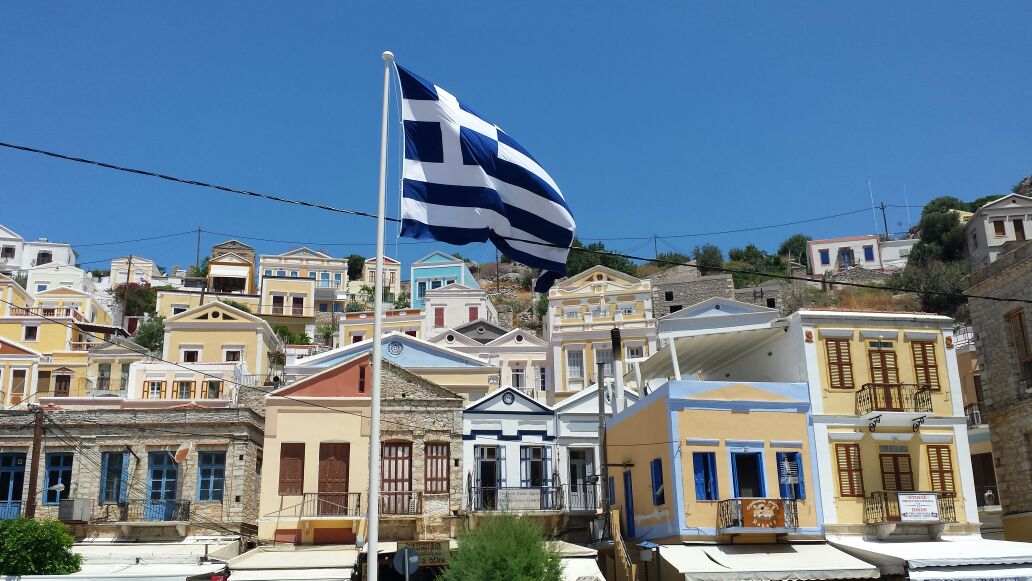
Today we upped anchor and sailed to Symi, an island 41 km north-northwest from Rhodes. Originally I had considered going there by commercial ferry but changed my mind and booked a trip with a tour operator. This would save hassle - especially as we would be picked up and returned to our regular pickup point at the Blue Sky hotel - but we also received the services of a tour guide, who explained to us no small amount of material.

The wiki article states that the island has become a haven for tourists from abroad, especially British and Italians, and is now the permanent home of about 120 non-Greek residents, some 50 of whom are British. The influx of tourists has led to the restoration of a great number of homes (many of which were destroyed during World War II); these restorations, by law, have to conform to "guidelines laid down by the Greek culture ministry's Archaeological Service." Between 1998 and 2006, it is estimated that the price of a "ruin" on Symi increased five-fold. The growing population of British and other expatriates has led to demographic as well as political changes, since EU citizens are allowed to vote in local elections and have attempted to exert influence on the island's politics. Opinions on whether this is a sign of growing integration differ. Our guide told a slightly different story: there is no new building, and as several rich Americans (including George Bush Jnr, if my ears heard correctly) have bought houses, housing prices have risen dramatically, making it very difficult for many locals to afford to live in Symi anymore. Apparently the average age of the town in 55! There are many houses which are unoccupied, due to the high cost of living.

There is a statue in the harbour, which according to our guide, is a tribute to a boy who in the 1950s tried to kill a shark who entered the harbour. This episode did not go well for the boy, and over-reacting, the government prohibited fishing. This was the major source of income for the island in those days, so the prohibition was very serious. The ban might have been expected to last a year or two, but apparently it lasted for 25 years, during which the skill of fishing had almost completely been lost.

As a result, the economy of the island was ruined, and now the only real source of income is tourism. In common with many Greek islands, there is no fresh water available on the island, meaning that almost all forms of agriculture are out. Aside from tourism, the islanders make some money from sponges and spices.

The harbour area is seriously gorgeous and the pictures don't really do justice: the italianate facades are beautiful. But aligned with this beauty is the sad story of the economy and the demographics - a population of 25,000 has dwindled to 2,500 in the summer, and virtually zero in the winter. There is one school with 250 pupils, from grades 1 to 12; as there are very few teachers, it often happens that a class is attended by 8 year olds along with 15 year olds.

After spending several hours in the eponymous town (and being gouged by the restaurant where we ate - the Aris Tavern), we set sail for the opposite end of the island in order to visit the Panormitis Monastery. For some reason, our guide disappeared (I saw him disembark but none of the English speakers found him on the promenade), so I don't know anything about this area. Again, there is a natural harbour, although less closed than the main one. The non-appearance of the guide had one advantage: I could go into the monastery and take pictures before anyone else. We were allocated an hour at this stop, although I was back on the boat after about 20 minutes.

From there, it was sailing back to Rhodos and a minibus to take us home. Very strong winds were blowing, which caused the waves to be very agitated on the west coast by the Blue Sky hotel: no evening swimming. We normally open windows in our little flat in order to allow ventilation and cooling from three directions, but the strong winds prevent this tonight - I could barely close the bathroom door because of the wind. I hope that tomorrow will be back to normal.

A very strong recommendation for this trip!

Thursday, June 08, 2017

Rodos log 4: Lindos and the seven springs

Yesterday we took an excursion which traveled on the western side of the island; today we traveled on the eastern coast to the 'resort' village of Lindos (where the big boat is on the map to the left), which is a 50 km trip. As opposed to yesterday, when we were the last to board (as our boarding place is on the west coast), today we were the first to board, so we could get the plum seats behind the driver. He drove back along the road along which we had just walked, turned left to go to the supermarket, where we picked up some more people, on towards the aquarium and thence down past the old city walls, through a very run down area of Rhodos Town and then onto the open road.

Our first stop was at a place called the seven springs (Epta Piges); no one should make this their final destination but it's ok to stop here on the way to Lindos. There is a little lake with seven numbered springs feeding into it (although we only saw six) and a larger lake with ducks. There are also peahens wandering around the parking area. A bit further on is another psychological exercise: there is a 100 metre long tunnel through which flows water to the depth of a few inches. People walk through this tunnel in the dark and come out the other end. I did this because other people did it; what did I get from this? Nothing. Why do other people do this? Maybe to test their level of claustrophobia. One person writes: if you go there, you really should walk through the tunnel, it's around 200 m long, and I wouldn't recommend it if you suffer from claustrophobia, because it's pitch black, water running under your feet, and it's really narrow ... but if you want something special to remember when you come home, go for it! It's said that if you go through the tunnel you loose all your fears and u [sic] will be 20 years younger, so now am 0 years then :) I saw a t-shirt yesterday evening with the legend "I'm not 50 years old: I'm 18 with 32 years of experience". So I've got nearly 43 years of experience ... but the above comment verifies the statement that "60 is the new 40".

The road to Lindos was fairly boring - to me, it's like being at home as the vegetation is similar.

Just before we got to Lindos, the driver stopped at a lay-by, where everybody gets out and takes pictures. Apparently Lindos is known as "the white town", which is very accurate as every building seems to be white. When we got there, we stopped at a junction outside of the town and took the shuttle bus down to the town square, saving a 1km walk down a hill (50 cents). From there we walked into the market ... and then proceeded to get lost (not literally) in the maze of little streets which were packed with people looking at all the items on display. This reminds me very much of the side streets of Sorrento. It bothers me less than the same thing in the old city of Rhodos town: there the streets are part of a historical site and should be viewed as such whereas here they are simply a market.

Probably the major thing to do in Lindos is climb up to the Acropolis, but as this involves walking up 500 steps (and walking back down), it was clear that our knees weren't up to the job. One can hire a donkey (for 6 euro), but after our experience with donkeys in Santorini, it was clear that this idea was a non-starter.

After about an hour of wandering around, we decided to stop and have a light lunch in one of the many rooftop restaurants. That's me on the left, overlooking some of the white town. After eating, we had to find our way out of the maze again, but this we managed to do without much difficulty. We discovered that we still had plenty of time before our bus was to leave, so we had a final cup of tea. To think that at one stage we were considering spending three days in Lindos: I would not recommend coming here to anyone who is on a tight schedule. The prices are also higher: the book about Rhodos which we bought in the old city for 7 euro costs 10 euro in Lindos.

In the evening, we went to the 3D cinema near the harbour, which is showing a twenty minute film, "The throne of Helios", which tells in very dramatic terms some of the history of Rhodos. Apart from being entertaining (the 3D effects were enhanced by moving chairs, "rain" falling from the sky and bumps in the back), the film also imparts a great deal of history. Following that was a six minute fun film about a chariot race: no dialogue but plenty of action. I had had the foresight to request a non-moving chair for this film as I was sure that my balance problems would give me grief. Everyone else in the audience was screaming whereas I was simply enjoying the film. This was definitely a highlight and strongly recommended. The history film costs 10 euro, and the chariot film an extra 3.

The evening finished by walking back to Mandilara street, having a light supper, then walking through the pedestrian area which was mainly composed of full restaurants with live entertainment. In the middle of the road was one almost empty restaurant - I wonder how they must have felt.

Wednesday, June 07, 2017

Rodos log 3: Filerimos and the Valley of Butterflies

The day's primary event was a trip to a hill called Filerimos, then continuing on to "The valley of butterflies". We reported, as requested, to the Blue Sky hotel pickup point by 8:50, even though the minibus only came about ten minutes later. We had to wait about 15 minutes before leaving as apparently someone had booked but not turned up. When we did start, we traveled on the road to the airport.

Filerimos is a hill overlooking Rodos town: there is a monastery which we did not visit, and about 1000 peacocks/peahens wandering around the grounds. The major point of the trip is the views: one overlooking Rodos (although this is one is hard to get as vegetation gets in the way), and one over the southern part of the island, along with the western coast. Apparently the site is popular with young people who go there to get married. We were given an hour to spend there, which is probably just right if one goes to the monastery, but otherwise is far too long.

After returning to the airport road, we continued traveling for another half hour or so, past the airport and on to the Valley of Butterflies. This was not quite what we had been led to believe: first there was a 1km continually ascending hike through dense woodland, with a stream and waterfall on one side. The path was mainly cobbled stones, making the walking hard. The only wildlife which I saw was two goats; I did frequently stop and look for butterflies, but I could see none. Eventually the part ceased and I arrived at a large open space - a cafe. There were paths which lead to another monastery but again, I didn't enter.

In the wasteland behind the cafe - some natural open land - I eventually saw some butterflies; at first I jokingly thought that there was only one, flying around, but eventually I saw some more - maybe five in all. After this, I decided to retrace my steps and return to the parking area.

I was very disappointed in this trip, but didn't see the disappointment reflected in other people's face - there were plenty of other people, although the place was not crowded. This is like a psychological experiment: people are told to visit here, so they visit, but they won't admit that they didn't enjoy themselves. I wouldn't recommend this to anyone.

Coming back to town at 2pm, we rested for a while, then went into the Old City via the  Gate D'amboise, which is in the north west corner, only a few minutes from our flat. At first I was very taken by the architecture, which is the palace of the Knights, dating from the fourteenth century, but my appreciation was sorely tempered by the fact that almost every available space was taken by either stalls selling more and more tat or by restaurants. Our "entrance area" had only a few people, but by the time we entered Socratous Street, the area was crowded. I was enjoying myself less and less.

Eventually I managed to navigate out of the maze, to an exit by the harbour. Just before existing, I chanced upon a music shop, selling bazoukis and other instruments. The name of the shop is Sakellaridis and the address is 9 Museum Square. The cheapest "real" bazouki costs 85 euro (although the proprietor is willing to give a discount for cash) whereas a toy bazouki can be bought for 35 euro. These prices are a bit too much for me, so I decided to compromise on a karimba and some pan pipes. My grand-daughter should have fun with the karimba.

From the harbour exit, it was only a short walk back to the modern harbour area which we know; we stopped for some refreshment then walked back to the flat. There was plenty of potential today but all in all, rather disappointing.

Tuesday, June 06, 2017

Rodos log 2: the Old City

While we were walking around the harbour area the previous night, I picked up a leaflet for a hop-on hop-off tour around Rhodes city: this is exactly what we wanted, but for some reason, our landlady was unaware of it. I could see from the map that there was a pickup point quite near us, although exactly how near wasn't clear. I woke up at about 5:40 am and went out for a walk: the first port of call was to see how to get to this pickup point ... five minutes away on a street behind us, next to the sea. After walking there, I then walked back via a different route, in effect retracing our steps from the previous day, putting everything into context, filming here and there and looking closely at street names. I discovered that we are staying at a different address from what I had been led to believe: at the corner of Fanouraki and Ammochostou.

After breakfast, we walked to the Blue Sky Hotel, which is the bus pickup, and waited. We arrived a minute after the published departure time of the first bus, but don't worry: the bus was a few minutes late. Tickets are 12 euro each, which is a reasonable price. Apart from us, there was only one other couple on board. We set off for another pickup point, then doubled back to get to the Aquarium, which is at the northern-most point of the island - one of the places that we intended to visit. From here, the bus cut through to the port area, where we had been the previous evening, and then onto the old city - stop number seven.


Here we alighted. The idea was to cover as much of the market streets as possible before being overwhelmed by the surge from the two large tourist ships docked in harbour (one of which being Israeli). This plan worked to a certain extent, in that the first streets that we walked through were almost deserted, but soon we met the surge: this was because we were entering from one gate whereas they were entering from another gate, and so we met in the middle. This picture shows that we were the first to arrive at this fountain.


By the time we arrived at the next fountain, the roads were already crowded and the restaurant barkers were in full voice, despite it not yet being 10am. Fortunately, the barker in the picture was silent, but there were others who compensated for him (also the parrot). After several more shops and about half an hour, we decided that we had seen enough and that it was time for a drink. We stopped at a cafe which was quiet and ordered a milkshake; "small, medium or large?" was the question. I plumped for a large banana milkshake as I was thirsty: big mistake. I should have asked to see what each size was like (and how much it cost) before ordering. The "large" milkshake was huge - the waiter told me afterwards that it contained 1.5 litres of milk!! It was also very expensive - 20 euros. It also filled us up so much that we had no need to eat lunch, which is probably just as well. In fact, even by evening I was still feeling full.


This cafe turned out to be right next to the entrance by which the day tourists had entered, so we were shortly out of the old city. We visited Rodos about ten years ago when we were on a cruise, for a few hours in the evening: this is where we entered the old city. Once outside, we walked around the wall, going back to the pickup point, where we waited for a few minutes in the brutal sunshine. Along came the bus and off we went. After the next stop (the tourist harbour), the bus drove around the southern part of Rodos town, which is less interesting but probably the only reasonable way of getting to the Acropolis, which is a high hill at the back which apparently allows a view of the southern part of the island. We didn't get off as it was very hot.

The bus continued on its journey, reaching the western coast, then traveled north, passing the first and second pickup points on its way. This road is full of hotels, which is why the bus passes here. We didn't get off at point number two, but instead continued again until the Aquarium, where we did get off. This being underground, it was cool, providing a respite from the heat. The aquarium itself was disappointing: whilst the exhibits - and fish - were good, there simply weren't very many of them. 

From here, we waited for the bus again, did a complete round trip, got off at pickup point 2, walked home and collapsed in the shower. It was now gone 3pm. After resting, I did a quick food run, then showered again. We intended to eat dinner early, but got waylaid by our landlady's mother who talked to us for about half an hour; whilst the personal touch is very nice, it wasn't particularly what we wanted to do. 

We went to the same nearby restaurant where we had eaten the day before, this time ordering lamb chops (wife) and chicken souvlaki. Whilst the food was very good, the service was also very slow: when we asked about this, we were told that the food is cooked over charcoal (which we knew) and apparently takes longer to cook than in a frying pan (which we didn't know). Tell this to the hordes of Israelis who cook over barbecues on Independence Day! 

We didn't leave the restaurant until 9pm, me smashing a plate by accident on the way out - but hey! it's a Greek restaurant, where plates are smashed on purpose later on in the evening. Our original plans for the evening had been ruined by the time, but I hoped that at least we could save one thing: booking some tours at the tour operator shop which was a minute's walk from the restaurant. Fortunately this was still open, so we booked trips for the next coming days. This required a little flexibility as not every trip runs every day.

See you at the Blue Sky Hotel at 8:55 tomorrow morning for the pickup.

Rodos log 1

As of yesterday, we are on holiday in the large Greek island of Rodos (Rhodes) for a week.

Yesterday, we got up at 3am in order to be ready for our 7:25am flight with Arkia (a daughter firm of El Al which handles short flights, both internal and external). Everything pre-flight went smoothly, and the flight itself was short: we were in Rodos by about 9am. We were met at the airport by our 'landlady' - we are staying in a small flat in the northern part of the city, a few minutes walk from the sea, the harbour and the old city.


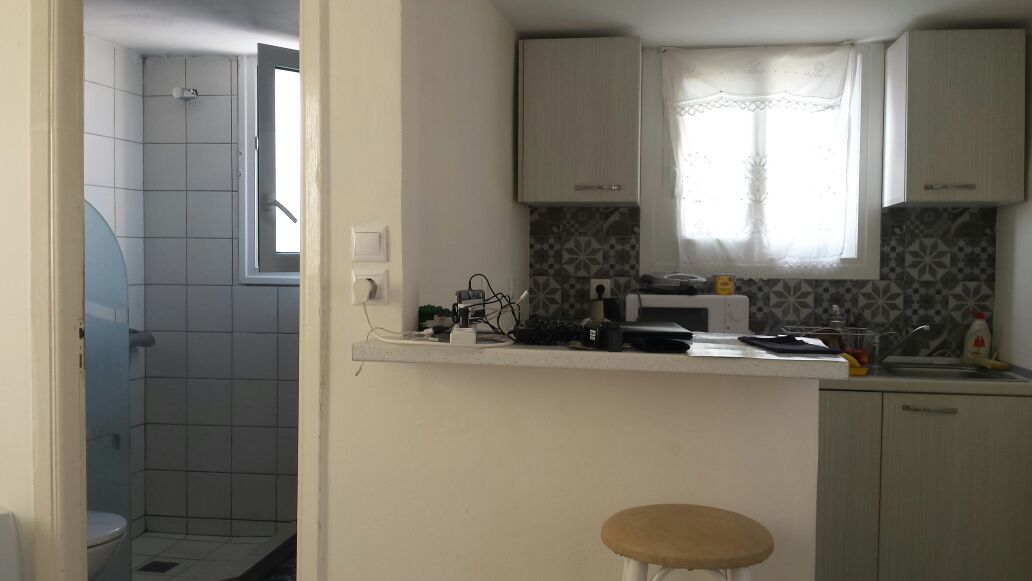
The flat itself is smaller than I thought it would be (isn't that always the case!), but it does come with a small kitchenette and a very large outdoor space, which is not a balcony but rather the roof over the flat on the lower floor. We are right at the top of the 5 storey building, with access via a lift to the fourth floor.
After a quick trip to a store to get some supplies (I misunderstood the directions given by the landlady and ended up in a shop with a very poor selection of food items), we laid down for a rest as we were both tired and it was very hot outside. Later, we went for a short walk around the neighbourhood, found the mini-market where I should have bought supplies, ate a very tasty (and very expensive, relative to our budget) sea bass, found a touristy pedestrian only street with some interesting shops, and finally a good supermarket (this is at the end of Mandilara street). We bought needed items then returned home.


When the heat cooled a little, I showered then went to sit on our 'balcony', reading and listening to music. After this, we went back out on the streets, turning right to the harbour district. We walked around this area for a bit, going out on the "long wave braker at Mandraki harbour" which stretches to the windmills and fortress, before returning home.

Everything is very close: walking at my natural speed would take me all of five minutes to get to the harbour on one side, and to the beaches on the other side of Rodos.


Wednesday, May 31, 2017

The music room (2)

It seems that I was slightly premature in uploading one of the pictures of my new music room - my wife did a little more interior decorating today.


Monday, May 29, 2017

The music room

The pegs which we bought last week have now been fixed on the walls and guitars have been hung on the pegs. So it's time to see what the music room looks like.

In the first picture are two mandolins, an autoharp, a Yamaha PSR-E 303 keyboard and a semi-acoustic bass guitar (influenced by Paul MacCartney's Hofner violin bass) which I've had since about 1980.
The only new instrument in this picture is my Avon copy of a Gibson SG, which I bought in 1976. The door leads to the bathroom.

Here we have the piano, Washburn semi-acoustic (in stand), Ovation acoustic (on wall), MIDI keyboard (on shelf), melodica (in case, at top), two amplifiers (on piano), and a few mini-instruments which are bronzes and not for playing.

Not pictured - because they are elsewhere in the house - are a violin (playable), an oud and the bagpipes.

Sunday, May 28, 2017

Sgt Pepper

I wrote a few days ago about an innocuous event which occurred 50 years ago, which later took on much more importance. A few days after that event happened another, whose importance was immediately recognised - the release of The Beatles' "Sergeant Pepper" album. Like the inaugural Fairport gig, this too passed me by at the time....

I've been trying to recall when I first heard any of the songs on this album. "Strawberry Fields Forever" and "Penny Lane" were well-known, as they were the double A-sided single which should have been on the album, but for the others, it seems that it was several years before I heard them. I definitely recall hearing "She's leaving home" at some stage during 1969, but without knowing what it was.

My English teacher in 1969, Mr Patten (who also taught PT and unfortunately died at an early age), once played for us "A day in the life" during a class. This would have been in the autumn term of 1969, as I remember that I and my classmates knew by then how to handle an album sleeve. He was illustrating the kinetic lyrics of the middle part ("Woke up, got out of bed"), before dissing the rest of the song.

When I first went to Israel in the summer of 1972, some of my friends amused themselves by singing all the songs from "Sgt Pepper"; I remember hearing the title song and thinking "aha, they're singing Sgt Pepper", but for me, this record was already passé. Back in Bristol, someone who sort of created a group with me (we never really played a gig) asked whether we could play "Lucy in the sky with diamonds"; I had seen the sheet music in a Beatles' song book and as it didn't seem too complicated, I said yes - without having heard the song, as it had been banned by the BBC. I think I eventually heard it in 1973, and when I did, I asked myself whether "this is that wonderful song that everyone has been praising for years?"

I get the feeling that I never heard the album in its entirety until I bought the cd in 1991. Now, a new deluxe two cd version has been released: the first has a remixed version of the original album, whereas the second contains out-takes and remixes of the single. I am still underwhelmed. Without deliberately trying to be contentious, my favourite song from the album is probably "It's getting better", followed by "Fixing a hole" and "She's leaving home", although all the songs are totally eclipsed by "Strawberry Fields" and "Penny Lane". I enjoy most of the other songs but don't feel any real enthusiasm to listen to them, unless I've been reading (once again) how the tracks were created. Typically, it is the second disc which I find more interesting: hearing the backing tracks for "She's leaving home" and "It's getting better" without vocals, which reveal hitherto unknown details.

By 1969, when I started listening seriously to music and "Abbey Road" was the Beatles album, I still preferred listening to "Unhalfbricking" (Fairport) or the first Nick Drake album. It wasn't until John Lennon's death at the end of 1980 that I (and probably many more) started listening once again to The Beatles.

Saturday, May 27, 2017

Fifty years of Fairport

27 May 1967. I was just a schoolboy in short trousers, a few months shy of my eleventh birthday, waiting out my final term at Henleaze Primary School before taking up my scholarship at Bristol Grammar School. At the same time, four young men walked onto the stage of a church in Golders Green, London: they had just begun calling themselves Fairport Convention. At the end of their show, another young man approached them and said that he could drum better than their current drummer; a tradition had set in right from the beginning of having a fluid line up.

I first became aware of Fairport at the end of 1969, from a magazine article entitled "Sounds of the 70s", in which the writer(s) discussed acts which were expected to achieve success in the 1970s. In the time between that initial show in Golders Green and the publication of that magazine article, a mere two and a half years, Fairport had already released four albums (a fifth, 'Heyday', featuring songs from this period would be released twenty years later), had recruited and released three singers, had suffered the misfortune of the van crash on the M1 in which the drummer died, and most significantly, invented the genre called 'Folk rock' - not the wishy washy American version, but full on rock treatments of traditional songs.

1969 was quite arguably the most successful year that Fairport had. The 1970 version lacked Sandy Denny, the 1971 version lacked Richard Thompson, and in 1972, the final remaining original member, Simon Nicol, left. Several very temporary line ups appeared under the Fairport name, but it seemed that the group had run its course - after five very full years. But no: Swarbrick and Pegg put together a new line up, combining forces with some of the survivors of Sandy Denny's Fotheringay, and a stable configuration appeared ... for about a year and a half. I didn't see the five member version, but I did see the group after Sandy returned.

That line up didn't last very long, and soon the group returned to the wilderness. I went to a festival in Southend sometime in 1976 which featured a very unusual line up - their picture appears on the sleeve of the atrocious "Gottle o'geer" record, but half of the people in the photo didn't play on the record. Fortunately, Simon Nicol (who engineered GoG) returned, and there was a very strong group for the years 1977-8, which I saw several times (including two times in the same week, when I finally met someone in the group). 

But by 1979, I had emigrated and the group folded - I know for a fact that my emigration did not play any part in the group's ceasing to exist. It wasn't until around 1986 that the group reformed and recorded "Gladys' leap". Although initially this was only a temporary group, Maartin Allcock and Ric Sanders soon joined to make a permanent group - which played together for an unprecedented ten years, at which stage Maart was replaced by Chris Leslie. A year later (1997), Dave Mattacks - drummer since 1969, although not during 1977/9, left, to be replaced by Gerry Conway (ex-Fotheringay). 


That line up is still playing, twenty years on! Full marks for longevity, but the sounds that they make are boring to my ears and only make me wish to hear the original recordings. 

So raise a mug to Fairport on their fiftieth birthday! They have been a part of my life for almost ever. It has to be said that their first ten years were so much better than the latter forty years.

Friday, May 26, 2017

Aroma AG-03M Rechargable Cube Guitar Amplifier

A 5 watt guitar amplifier sized 10X14X5 cm, with an onboard rechargeable battery and a clip which allows one to attach the amplifier to one's belt, and only costing $33, including postage? Sounds too good to be true - but there is such a device - the Aroma AG-03M Rechargable Cube Guitar Amplifier. At that price, one can't go wrong, even if the amplifier is a dud.


I ordered this device from DX in the middle of April, and it arrived the other day. Today I brought it home and tried it out. First, the battery had to be charged (with a USB cable, exactly like a mobile phone) - the documentation says that the initial charge should take six hours, but it seemed to be complete after about two.

So I turned it on, connected a guitar - and had my ears blown out. Once I turned off the distortion (this is the default setting), the volume was reduced greatly - a bit too quiet. But otherwise the mini-amplifier seemed to be fine, and certainly value for money. This makes it a fine practice amp (especially as one can move around with it) and maybe a busking amp, but not a performance amp.

As with all devices these days, it is possible to add a memory card. I naively thought that I could record onto the card, but it would seem that the card's function is to play stored songs back through the amp - i.e. turn it into an mp3 player. I don't have a spare memory card at the moment to verify this, but it would seem that one can't play back songs and amplify guitar at the same time - a bad design decision as this functionality would have improved the ability to practice along with music. There is a microphone socket (3.5mm) which presumably works in parallel with the guitar.

I wish I had something like this 45 years ago.

Incidentally, talking about guitars ... I was in a guitar shop the other day, in order to buy pegs from which I can hang guitars on the wall. There was a beautiful 12 string guitar there, apparently a Fender CD-160SE 12-String V-2: this has a good sound and is smaller than I had expected - very comfortable to play. As with all guitars these days, it comes with an onboard pre-amp, which allows one to connect the output to an amplifier (or effects). The price is a bit expensive for the moment (around $800), but I'm hoping to buy it for my birthday in a few months, especially if I can spread the cost over 10 payments (as I did for the guitar pegs and the piano chair that we bought).

Monday, May 22, 2017

Puzzle from the Guardian

This puzzle comes from here:

In each of the four sectors of the outer circle, there is a two-digit number which is equal to the sum of the three numbers at the corners of its sector. The numbers in the individual circles can only be 1 to 9 and each number can be used only once. One number has been provided to get you started. Find the remaining four numbers


Friday, May 19, 2017

In blissful company

The first inkling, like many others, came from the seminal Island Records compilation, "Nice enough to eat". After the rage, fury and musical precision of King Crimson had shattered into a thousand pieces, a jaunty bass riff took centre stage. The riff was taken up by other instruments, turned into the backing for a vocal section, leading into a long trippy guitar solo, followed by a chanting section and then returning to close the song. This was "Gungamai" by Quintessence, an ode to the river Ganges. The British underground meets the Indian sound. Listening to this song now, I realise that it is based on one chord.

In those days (1970), it could be very hard to find out about groups, especially the more obscure ones. One was limited to what appeared in the music papers - in those days, only the New Musical Express and Melody Maker (Sounds joined to make a triumvirate in 1971). It would never have occurred to me to request a press package from the record company. So Quintessence were very much an unknown quality.

Intrigued by this song, I found a single by Quintessence, entitled "Notting Hill Gate", whose lyrics seemed to be "We're getting it straight in Notting Hill Gate, we all sit around and meditate". When I found myself with a few hours spare in London in July 1970, I duly headed to Notting Hill Gate, trying to find this mysterious group but did not succeed. In the following year, I saw the group in the Victoria Rooms in Bristol and was so moved by the experience that I wrote a gushing letter to either their management or to the record company. I was even more moved when the letter appeared in Melody Maker the following week - betrayed, because the letter had been transferred to a third party, elated because I had a letter published in MM.

I bought the second album by Quintessence, which had a very elaborate sleeve. This record impressed me less than their opening salvo, as lyrically it was too religious and musically it was less exciting. My enthusiasm waned demonstrably when I heard the title track from their third album, "Dive Deep", and so all things Quintessence dropped from my radar.

A few years ago, I began trying to track down the music of my youth which fell outside of the axes of Fairport, Van der Graaf and Crimso. A surprise find yielded the first two albums of Quintessence, which is when I discovered that the version of "Notting Hill Gate" which I remembered was a different - shorter and poppier - arrangement to the one which appeared on their first album, "In blissful company". These days, I find that first album more interesting that the second.

It seems that I am not alone in my renewed interest in Quintessence: a few months ago, the online music magazine Siiye published an article about the group which was very interesting, as I never knew much of their background. Following that article, another website announced that their first three Island albums would be repackaged as a double cd, and sold along with a 48 page booklet in the near future. That near future is now and the double cd has landed.

The booklet - whilst informative to a certain extent, giving a potted history of their early days - is almost unreadable, being printed in white letters on a multicoloured background. The credits page is printed in black, but on a pink background, making it also almost illegible.

And the sound ... well, I have been listening to these albums in the past few years. The rhythm guitar, when isolated, is embarrassing in its sound, but fortunately it is kept mainly in the background. The real blooper is the opening track, "Giants", which starts with the rhythm guitar playing barre chords up and down the neck, followed by a cringe-inducing vocal, "Once there were giants". Fortunately, everything picks up after that; but why start with what might seem to be the weakest track?

The compilation, consisting of their three Island lps along with both sides of the afore-mentioned single, is called "Move into the light" - the name of the song on the b-side of NHG.

Monday, May 15, 2017

An unintended prophesy comes true

I am rereading Neal Stephenson's "Cryptonomicon" once again. I am 49% through the book, if anyone is interested, in a chapter entitled "Hoard". Randy Waterhouse is in a plane, flying from Manila to California. There is a paragraph which reads like the following (somewhat abridged, as I have to type this) ...

There are three messages from Kia, Epiphyte's only actual employee, the administrative assistant for the whole company .... It is some sort of a federal regulation that nascent high-tech companies ... must hire topologically enhanced twenty year olds with names that sound like new models of cars.

Obviously the above is another of Stephenson's jokes, but I don't think that he expected that one day there really would be a type of car called 'Kia'.

Wednesday, May 10, 2017

DCI Banks - Wednesday's child

I wrote a few days ago about watching the televised version of this story. I had only seen the first half when I wrote - I was in for a surprise in the second half, when the story became almost a complete reversal of the original novel. It is clear that the relationship between the written word and the dramatised word is fast approaching zero.

Naturally, I had to read the novel again, especially as I remembered it as being one of the best of the early Banks novels - an arbitrary line drawn by the arrival of Annie Cabbot. This book features Superintendent Gristhorpe (Banks' superior) in a more active role than usual. It also mentions towards the beginning how Gristhorpe, as a young uniformed police officer, took parts in searches for the victims of the Moors Murders, and how he heard tapes of the perpetrators torturing children to the sound of carols - which turned him permanently off music from then on, always pretending to be tone deaf.

Which makes it very strange to read at the beginning of chapter 12 that "Besides, Gristhorpe was tone deaf; for all his learning, he couldn't appreciate music". This is a sentence which must have been written in a reflex manner; it's always something that comes up when Gristhorpe is mentioned. But as we know - having already read so at the beginning of the book - Gristhorpe is not tone deaf, he just does not like listening to music. This is a sentence which should have been removed by a sharp editor.

Tuesday, May 09, 2017

Zingers

I warn in advance that this blog isn't going to mean much to anybody except myself, but it's therapeutic to get the following off my chest....

By chance, "You've got mail" was shown once again on the television of Saturday; I came home from walking the dog in the late afternoon and found my wife watching it. There's a scene early on, after Meg Ryan meets Tom Hanks at a party and discovers who he is, when Hanks writes the following: Wouldn't it be wonderful if I could pass all my zingers to you and then I would never behave badly and you could behave badly all the time and we'd both be happy? On the other hand, I must warn you that when you finally have the pleasure of saying the thing you mean to say at the moment you mean to say it, remorse inevitably follows.

I haven't had the dubious pleasure of saying the thing you mean to say at the moment you mean to say it, but I did write an email to a fellow worker this morning saying that I am not prepared to compromise my principles by omitting data from a report. I also wrote that I was saddened by the amount of energy that this worker has spent trying to persuade me, and that this energy would have been put to better use in correcting the data which she doesn't want displayed.

Don't people understand that a principle of reviewing data is that everything has to be shown, warts and all? For the minute one sweeps bad data under the carpet, one loses the ability to see that something is wrong and then that something will never be corrected.

What's sad about this entire episode is that I feel terrible inside. And that's ironic: I feel bad because I did the moral thing and stood by my principles. I don't feel remorse at having written what I wrote, but I feel very uncomfortable and not sure that I can continue working with such people.

My manager (who is the CFO) supports me, but she's not the one who is fighting the battles in the trenches. I shouldn't have to fight at all.

Saturday, May 06, 2017

Television detectives

I don't know why the British have a fascination with police programmes on television. As a child, I can recall watching "Z-cars", which was followed by "Softly softly". There was a tendency towards American shows during the 70s ("Starsky and Hutch" was required viewing), but the trend reverted to British shows during the 80s and 90s ('Morse', 'A touch of Frost').

At the moment, I am watching three different police programmes on television. 'Line of duty' - to which I have referred in the past - is now in its fourth season and is being shown here about one month after being shown in Britain, which is remarkable. This programme differs from others in that it shows policemen investigating policemen, as opposed to policemen investigating crimes. This is an excellent series, and one never knows what is going to happen. Apparently the show is scheduled for another two series.

Second up is 'Unforgotten', which is in its second series. This shows a unit which deals with cold crimes - murders committed thirty plus years ago. This is much more a drama series than a police procedural and as such is very well written. But looking beyond the story itself, one sees several items which deserve explanation. Such a unit in real life would normally be where unwanted or burned out officers are placed; the officers in this unit are young and good at their job (the researchers are exceedingly good).

The deputy chief has even been promoted from Detective Sergeant to Detective Inspector between the first and second seasons, but no explanation - or celebration - was mentioned. The home life of the deputy chief is also unexplained: he has two teenage daughters but no wife. It's not clear whether he is a widower or abandoned by his wife; if the latter, then it seems strange that a very busy detective would win custody - unless, of course, we only see his daughters when they are with him. But this doesn't seem to be the case. A good rule of drama is "don't add unnecessary complications": whilst these scenes are supposed to make the character more interesting, they also throw up unanswerable questions.

The third programme, which has just started being shown again, is the third series of my old friend, DCI Banks. I have carped enough about this programme in the past, but I won't be returning to any of my old criticisms. The story in the opening episodes is based on a one line description of one of the better earlier Banks books, but otherwise is a completely new invention. Thus I don't know where the story is going, and instead of complaining about how the original has been adulterated, I can watch the show with new eyes. My earlier complaint about the apparent continual stroppiness of the titular character has been answered: he is now much more calm, but the stroppiness has been transferred onto his subordinates, specifically DI Morton (a character invented for the screen presumably because the actress playing DS Annie Cabbot went on maternity leave) and DS Cabbot. I doubt very much whether police officers could continue to behave the way that DI Morton does without being reprimanded. As opposed to the other programmes mentioned here - and as opposed to the books - I can't see any special characteristic which defines this programme and differentiates it from others. This lack of differentiation lowers its value.

Thursday, May 04, 2017

Priority tip: default parameter values

Procedural (and report) parameters in Priority have an admirable quality: they are maintained from invocation to invocation. Thus if I run a report which requires a date parameter and I enter today's date, that date will appear automatically the next time that I run the report. Most of the time, this is a good idea, but sometimes it is better to have predefined parameters - for example, a report will run on dates from 'the beginning of the previous month' until 'the end of the previous month'.

I am not aware of a method to do this in a standalone report, but it is simple to do this in a procedure: a parameter is defined with a default value in an INPUT step. In a second step (probably SQLI, but also INPUT: there seems to be little difference), the parameter is referenced again, marking its type as 'd' in the 'extensions' subform of the procedure step. This 'd' tells the report engine to use the default value provided and not the last used value.

This technique is fine for date and numbers, but someone recently asked me to prepare a report where the customer number has a default value. Customer numbers of course are stored in the customers table, so defining the parameter would not be the same as defining an unbound date or number. Originally, I had no idea how the request could be successfully answered, but then a few days later, I stumbled on the standard 'delete parts' procedure. This procedure presents an interface similar to the search bar of a web browser: the words 'enter search here' (or similar) are displayed automatically, but these words disappear when one starts typing. In the same manner, the 'delete parts' procedure presents the standard screen for entering a parameter, but displays 'enter part number' in the space for the part number. This is the technique which can be appropriated.

Again, the process has two steps: in the first step, a variable (NOT a parameter) is given a default value, e.g.
:DEFAULT = '11143';
Then in the screen where one defines the parameter for choosing customers, one enters in the 'value' field of the parameter the predefined value :DEFAULT. One also has to enter the 'extensions' subform and mark the parameter with type 'd'. The result of the above is that the customer number '11143' will be displayed automatically although it can be overwritten.


The above is not just an academic exercise: someone else complained that a given report wouldn't work - even though it worked perfectly for me (as usual). This is a clear sign of a problem with one of the parameters being passed to the report: it transpires that I listed a range of suppliers whereas this person left the suppliers field empty. I can now improve this report with the 'default parameter from a table' technique by giving the suppliers field a default value to ensure that the report always works (unless someone perversely deletes that default value from an invocation).