Friday, May 19, 2006

Strumming the guitar - stage two

Things have been hectic at work over the past few weeks, which generally means that I don't do anything much with my 'own' time. Now that the pace has relaxed slightly, I thought it a good idea to go back to my MIDI strumming program. As it happens, it's exactly one month since I last wrote about it.

First off, I solved a few of the problems which I had left open:
  • Choosing different voicings of the same chord
  • How to represent strings which aren't played in a chord
  • Time signatures
The third problem wasn't really a problem when I thought about it: a strum's time signature is implicit in its pattern, so all I had to do was remove any code which might have attempted to affect the time signature. Obviously one is not going to use this program in order to strum along with material by National Health (or even Debussy's sublime "Afternoon of a fawn") in which time signatures change frequently.

Choosing different voicings also turned out to be much simpler than I had originally imagined: all it needed was to add a 'version' number to each chord (for example, "E minor7/1" and "E minor7/2" which will be enough to differentiate. Although one might think that there would be problems matching a chord like 'E7/9', this is not so. 

Unplayed strimgs also turned out to be a 'paper tiger': the string's value is set to 'x', and elsewhere the code knows that an 'x' note should have the MIDI value 0.

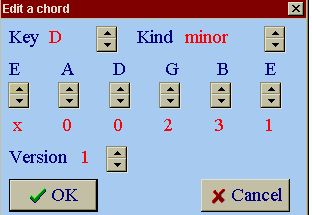
Here's a screenshot of the chord definition screen:

Once I had got all those problems out of the way, I started on the 'MIDI substitution' code. The idea here is to create a MIDI file consisting one bar of strummed E Major, and then to copy the values contained within the MIDI file into the new file, where the notes of E Major are substituted by the notes in the chosen chord. Whilst this wasn't easy to do, it also wasn't as hard as I had expected. The code uses procedural variables which simplify matters. In the great tradition of information hiding, the calling program sends a chord shape to a routine called 'WriteChord'. without knowing how that routine is actually implemented. The user is presented with several strum patterns, and after a pattern has been chosen, the 'WriteChord' procedural variable is set to the corresponding procedure for the chosen pattern.

The first pattern which I used with the substitution algorithm didn't finish correctly, so I had to edit some of the final delta times in order to get the timing correct. The second pattern which I tried came out correctly.

Now all that's left to do is enter more patterns, which is very much grunt work. There may still be a problem with time signatures - these are coded somewhere in a MIDI file's prologue, and of course at the moment I'm using a 4/4 signature. I imagine that this will be resolved by a flag being set if a specific pattern is in 3/4 (or even 5/4, gasp); prior to writing the file, the signature bytes in the prologue will be modified to the correct value.

I've decided to punt on the issue of chords changing halfway though a bar. The user can manually edit the resulting MIDI file.

Monday, May 01, 2006

The dream is over

As John Lennon once sang, "The dream is over". The dream to which I am referring is that of Maccabi Tel Aviv (the basketball club), who dreamt that they would become Euroleague champions three seasons in a row, a feat which hasn't been achieved in nearly 20 years. My, they were close....

Were Maccabi right to have this dream? Yes. Did they deserve to win the championship? No. In my opinion, it was only a fair amount of luck which managed to get them into the final at all. True, the semi-final game against Tau Vittoria showed the players in excellent form, but that game had them playing maybe twice as well as they had played all season, and unfortunately gave false hope regarding their ability in the final.

I consider myself to be far from qualified to give a learned opinion on the subject, but like every other Israeli, I too have an opinion about Maccabi. They should never have signed Will Solomon as point guard, and if having done so, they should have signed a backup point guard (Derrick Sharp is not really a pg). Last night's game showed every thing which was right and wrong about Solomon: yes, he can score three point baskets. Yes, he can penetrate. And yes, he holds the ball for too long, wasting time and often getting into trouble. When he does eventually pass the ball, whoever receives it doesn't have very much time on the clock to do anything valuable with the ball.

Maccabi's best moments last night came when they scored within eight or ten seconds of the possession. Any longer, and the defence would be too strong for them.

Even though last night's game was tough, gritty and not enjoyable as a basketball game, I have to say good words for CSKA, the new Euroleague champions. Whilst they did not play attractive basketball, they had an iron strong defence and simply did not let the magicians of Maccabi do anything with the ball. Baston was almost completely neutralised on the offense because Vujcik couldn't get the ball to him. European season MVP Anthony Parker was merely a shadow of himself, presumably because whoever was guarding him did it so well that AP never got the chance to show his abilities.

But we're talking dreams here. Even at the opening stages of the season, Maccabi had good games and had bad games, an unevenness which didn't speak well for the rest of the season. There was even talk after the first few games of replacing Solomon; in retrospect, maybe Maccabi should have swallowed their pride and replace him. By a momentous amount of luck, Maccabi finished first in the initial group, thus avoiding CSKA, Tau and Panathanaikos in the next round. They could easily have finished third, and then this season would have been a different story.

This luck gave lie to the false hope that Maccabi could do the threpeat. In the second round, they initially lost to Real Madrid (I wrote about this here) and nearly lost to Ulker. But the Maccabi magic - or luck - held true, and again Maccabi was lucky to finish first in the group, thus achieving home court advantage for the quarterfinals. The hope meter was steadily rising even though Maccabi hadn't really played well enough to justify that hope.

The three game quarterfinal against Olimpiakos showed a Maccabi which was no longer head and shoulders in front of all the other teams; rather, it was maybe even a shoulder behind. But somehow Maccabi managed to win (the home advantage played its part) and managed to get to the Final Four.

On the strength of their past few games (and also the fact that they had lost a few Israeli league games, something which happens only rarely), I really didn't expect them to beat Tau. But then Parker and Baston played their game of the season and truly trounced Tau. All they needed to do was maintain that same level and the threpeat would be theirs.

But no. I have been wondering for some time what the next season will hold. I mean, had Maccabi won the championship again this year, would they go all out to win it for a fourth time?? How many of the players would have the same fire to win next year? Haven't other coaches learnt how to beat Maccabi yet? I don't know what the contract status is, but I imagine that several of the senior figures will leave Maccabi and next year will be a transitional one.

Read all the gory details about the game at the Euroleague site.

Thursday, April 27, 2006

Enjoy your metropause

I stumbled upon a website called 'I love reading' a few weeks ago, which as one might imagine is a site devoted to books. What is good about this site from my point of view is that one is able to read the first chapter of most of the books, which allows one to form a good opinion of the book's qualities and the writer's style. Amazon has something similar, but for only a small selection of books; also ILR allows the chapter to be downloaded as a pdf file, whereas Amazon displays a non-printable first ten pages on the screen (and those ten pages often include a title page and a contents page, so it's not even ten pages).

I went through the different genres and read a few opening chapters of books whose description had caught my fancy. It's just as well I read those chapters, as most of them solidly dissuaded me from even thinking about purchasing the books. But in the biography/autobiography section, I stumbled upon a minor gem - "Tales of the country", by Brian Viner. This is the story of a family that undergoes the metropause, which can be defined as the midlife urge to leave the city, to swap a tiny garden for several acres and to exchange the sound of hooting traffic for tha of hooting owls. If I hadn't done this myself nearly thirty years ago, I would be tempted to do so now.

After reading the opening chapter (which as usual gives a slightly misleading hint as to the tone of the book), I resolved on the spot to order the book. The recommended retail is seven pounds 99, but lovereading were prepared to sell it for five pounds 99. Out of curiosity, I checked the book at British Amazon, where it was selling for only three pounds 99. As ordering one item is normally not cost effective regarding the packaging, I decided to get an item residing on my wish list - the dvd of the second season of "William and Mary".

The book arrived on Sunday, after a few days after my order. Reading the first chapter again was revelatory as I discovered that the online version was slightly edited from the real thing: not enough to make a real difference, but disconcerting none the less. I read the book all the way through (as I always try to do with new books) during the course of one evening.

The book is throughly entertaining, as one might expect from a newspaper columnist (Viner writes for The Independent as well as freelancing), but on finishing the book I was left with a slight taste of disappointment in my mouth. To be sure, the book did tell about the Crouch End family moving to deepest Herefordshire and how they passed their first year, but a large amount of the material was anecdotes which came from the mouths of the odd collection of characters that the Viners met in their new abode. An uncharitable person might consider this to be padding.

Viner comes off as a lower quality Bill Bryson, which is a shame as he could have written a lot more from his own (or from his family's) perspective instead of always settling for the bon mot. The name of Viner's column is indeed "Tales from the country" (although it only became this after he moved), and he paraphrases some of the items which appeared in the columns along with their responses. Although a collection of the columns might be considered simple recycling, printing a few ad verbatim might have produced more original material which could have replaced the borrowed anecdotes - unless of course the columns themselves contain the same stories.

Minor carp aside, I can definitely recommend this book to anyone who has heard the siren call of the metropause as well as anyone who enjoys Bill Bryson or countryside anecdotes.

Tuesday, April 25, 2006

Creaking bones and aching muscles (Slouching towards Jerusalem, part 2)

Our kibbutz is situated just before the Judean Hills begin, whereas Jerusalem is situated on several hills (and naturally is surrounded by valleys). Thus not only did we walk 28 kilometres on the ground, we also rose 600 metres in altitude - and those 600 metres were much harder than the 28 kilometres!

The route started actually a few kilometres from the kibbutz, opposite Moshav Eshta'ol, and the first (and very easy) kilometre was to the Holocaust Martyrs' Forest. Before the Holocaust Museum in Jerusalem was established in the 1960s, this forest had been the official Holocaust memorial site. All along the path there were plaques saying that this grove had been planted by the X family in memory of Y who died in the Holocaust, and this grove had been planted by the A family in memory of B. We held a short memorial ceremony at the small parade ground, thus anticipating the official Holocaust Memorial Day (which is today) by a few days.

From there, we walked through the forest to a spot near Moshav Kisalon, all the time gaining in altitude. Here we were given a talk by one of our kibbutz founders (and a grandmother of one of the children) about her experiences in the Jerusalem corridor, prior to and after the Declaration of Independence in May 1948.


We then spent about another four hours walking (and having frequent breaks, including lunch) before arriving at a spring and pool called Ein Limon ("the lemon pool"), which is the Hebraicized version of the original Arabic name. The children had time to freeze themselves in the small pool which is fed by the spring, before we were introduced to the youth leader of the neighbouring Arab village of Ein Rafa. He told us about the village, its history and its small population. It transpires that one of the remaining tasks for the children is a series of meetings with the children of Ein Rafa. I imagine that there will be two meetings: their children will come to the kibbutz for an afternoon and ours will go there for an afternoon. Although our children learn Arabic at school, they only started this year, so they won't be able to say very much to the other group.

The weather had been good all morning: cool with a breeze. After lunch, it heated up and the first hour after lunch was slightly unpleasant. But after Ein Limon, the temperature dropped again which was just as well as the next leg of the walk, albeit only slightly more than one kilometre in length, was also the hardest as we ascended a couple of hundred metres!

This stretch brought us to a grove in the foothills of Kibbutz Tzuba. Here the advance party had already prepared dough, and once everybody had recovered from the walk, the children started baking pita bread over a fire. Later on, all the parents (those who hadn't walked with the children) arrived, bring a magnificent dinner, and much fun was had around the campsite. I, unfortunately, found it very difficult to join the gaiety as I had a severe case of dyspepsia, probably caused by forgetting to take my daily anti-stomach acid pill in the morning, and exacerbated by the immense physical effort needed for the last kilometre. It was also extremely cold and I had neglected to bring any long clothing for the evening.

Quite a few parents camped out with the children that night, but I had previously announced that there was a limit to my masochism, and I slept in my own bed that night. But I was up again the next morning at 6am to be taken to the campsite along with a few other parents who had done the wise thing.

After breaking camp, we walked in the direction of Hadassa hospital, stopping to eat breakfast at another natural spring, Ein Sataf ("Ein" means 'spring' or 'well' in Hebrew), where we were given a talk by a representative from the national nature reserve company ("Keren Kayemet"). As there was clear, flowing water, there had been an extensive Roman villa in the area as well as a small village, although in later years the village had been dispersed. In the 1980s, the Keren Kayemet had started rebuilding the area, and now it is a fine document of how people once lived: stone buildings and agriculture fed water by hand-manned canals.

Ein Sataf is high in the hills, overlooking Hadassa hospital which is on another hill. So of course we had to go down before we could go up again. The first part of the trail from Ein Sataf to a roundabout near Hadassa was very pretty, but we had to walk in single file which spread the party out over quite a distance. Once we had descended to the valley floor, the path was very wide - and the sun was also making itself felt.

From the roundabout, we didn't turn right to Hadassa (which would have been out of our way); instead we carried on straight ahead and climbed a small hill in order to get to the Arab village of Ein Kerem, which is on the outskirts of Jerusalem. This village has been gentrified over the past thirty years and is quite a desired residence. Most Saturdays - and we were there on a Saturday - it is full of Israelis taking a spot of nature and eating a meal in one of the many outdoor restaurants in Ein Kerem. We marched through the village and stopped at a picnic site on the far side (the side closest to Jerusalem), where we too had our lunch, freshly bought from the restaurants of Abu Ghosh, an Arab town to the west of Jerusalem well known for its humus and felafel.

After partaking and resting, there remained just the small task of ascending to Mount Herzl, which is the Israeli equivalent of Arlington Military Cemetery: all the (dead) Israeli presidents are buried there, along with other luminaries such as Herzl himself as well as Yitzhak and Leah Rabin. This stretch seemed to be never-ending: it was probably about two and a half kilometres long, but again we ascended some five hundred metres at the same time. The sun was also making itself felt, making this stretch very hard (but not as hard as the previous day).

Eventually we arrived at a memorial site for Raoul Vallenberg, which is just behind the military cemetery. Here we were greeted once again by all the non-combatant parents along with siblings. After we had got our breath back, we had a short ceremony presided over by one parent acting as King David: all wayfarers who arrive in Jerusalem by foot are traditionally feted with challa bread and salt.

From there we walked another four hundred metres or so (will this walking never stop, I ask myself) to the cemetery and thence to Yitzchak Rabin's grave where we held yet another ceremony. After some readings and songs (the heat had caused my guitar to go completely out of tune), a representative of the Jerusalem City Council gave us a speech and presented each of the children with a certificate, commemorating the event.

From then it was home, drink, food, shower and bed. A once in a lifetime experience (although some parents have done it more than once). I'm pleased that I took part and I'm pleased that I won't have to do it again!
Sunday, April 23, 2006

First aid

On Thursday afternoon, just after 2pm, two people came into my office. "Come quickly", they said. "We need first aid". As I did a three week first aid course in the army (25 years ago!) with occasional refresher courses, I seem to be the first call for any first aid needed in the factory. We walked briskly to the factory floor where I was shown a man, who for all intents and purposes seemed to be asleep.

I checked his pulse (which was maybe a bit high) and breathing (fairly obvious as he was making snoring noises), and that's about the limit that my first aid training could handle, except for the next part: call an ambulance!

After ten minutes, in which no ambulance appeared, someone called the clinic on the kibbutz, and after a few minutes our doctor (who was fortunately at the clinic) and two nurses appeared. First they administered oxygen and then the doctor began to check the patient: stethoscope, reflexes, etc. It was then that the diagnosis became apparent: a cerebral incident, or stroke.

After another ten minutes (which seemed like eternity), the ambulance arrived, and its crew took over from our clinic staff. Apart from inserting a cannula into the patient's arm and administering a dose of valium, they only measured his vital signs, and basically concurred with our doctor's diagnosis. A few people helped us transfer the patient to a gurney, and then he was into the ambulance and off to hospital.

I was informed on Friday morning that he had died during the night.

Everybody did what they could, but I get the feeling that there wasn't very much which could have been done. I was on the scene within a few minutes, and although I didn't realise it at the time (it's not often that I see someone in this condition), he was probably already gone and nothing could reverse what had already happened.

Thursday, April 20, 2006

Printer ate my fours

I've just had a really weird experience: after working on an Excel spreadsheet, I sent it to a communal printer to be printed. The output looked very strange, and it took me a while to realise what had happened: every '4' in the spreadsheet had not been printed!

If I were someone who knew nothing about computers, I might assume that all the '4's contained in the printer had been used and that there were none left to print my document.

I send the document to another printer and this time it came out ok.

The question still has to be asked: what happens when another user sends a document to the four-less printer?

Wednesday, April 19, 2006

Strumming the guitar - stage one

Programming realistic guitar strumming into a MIDI file is very difficult. Played on a keyboard, such a chord might consist of three or four notes, all them starting simultaneously and with the same volume. Apart from the trivial fact that a guitar has six strings and so any chord produced will be musically different from the basic keyboard version, a strum cannot play each string simultaneously. The notes have to be staggered by a varying amount and will have differing volumes. There are upstrokes and downstrokes, meaning that the resulting arpeggio will have notes played in a different order. Also downstrokes (from top string down to bottom) tend to be quieter than upstrokes. This is why there are very few realistic sounding guitar parts in MIDI files which one can download from the Internet, and virtually no guitar parts whatsoever in any of my files. 

Two and a half years ago, being aware of some of the above problems and thinking it about time that a guitarist have some guitar parts in his MIDI files, I started work on a program which would export a MIDI file containing notes purporting to come from a guitar strumming a series of chords. Apart from defining a mechanism allowing the user to enter chord shapes, I didn't do very much with the progam, and it's lain abandoned ever since. I was reminded of it the other day after deciding to purchase a library of MIDI guitar strumming. Obviously, one gets what one pays for, and 15 pounds sterling didn't get me very much. On the other hand, there wasn't much of a choice: most of the programs and libraries which I saw were either for the Macintosh or as add-ons to sequencing programs that I don't own. The library itself consists of several pairs of files, each file containing one strum pattern for several chord shapes (the second file in the pair consists of the same pattern for more exotic chords). I tried creating a sample song, in order to get an idea of what the files were like when I ran into a fairly major problem: a song is going to have a chord sequence, which means either copying the strum pattern for one chord and then editing it, or copying a bar from one chord followed by a bar from another chord. This might be practical (if rather tiresome) but for one problem: in order to make the strums sound realistic, they would often start before the beat. Copying and pasting would not only be tiresome but would also involve a fair amount of tedious editing, moving several notes backward in time. It's a shame that the library creators didn't think of this: starting the first note of the strum on the first beat/tick of a bar. Although this wouldn't be very realistic, it would at least allow the user to create a proper chord sequence, which could then be moved back eight or twelve ticks and thus attempt the realism. 

I was considering editing the library to achieve the above (and may still do) when I remembered the strum program which I had tried to write. In preparation for the MIDI export part, I had analysed several simple MIDI files as well as perusing the MIDI specification. I had even written a small program which exported a MIDI file containing a four note staggered chord; this was enough to show me that writing a strummer program was going to be much more difficult than I had originally imagined. When sequencing MIDI, one places the notes on the stave where one wants them, defining their length - just like writing music on manuscript paper. 

But a MIDI file is not like that at all: it consists of events (such as note on and note off), where each event has a delta time - the number of ticks before the next event. This might be manageable when programming a monophonic instrument such as a flute, but is exceedingly difficult when trying to program a guitar, which could have six 'instruments' playing simultaneously, although each with its own start and stop time. To do this properly requires laying out all the events on a time line and then figuring out the delta time for each event, not a trivial exercise. Then there are variable length quantities - a strange concept to a veteran Pascal programmer, used to values such as 127 and 129 requiring the same amount of storage. I suppose the idea was to minimise the amount of data flowing between different MIDI machines which were communicating at a rate barely capable of maintaining the latency required. One forgets that the MIDI format was initially developed to allow machines such as analogue synthesizers to communicate with other machines, such as tape recorders; it was not developed as a file format for programs to output music from a sound card on a computer. Anyway, the variable length quantities means that 127 can be stored in a single byte, whereas 129 has to be stored in two bytes (of which the first has to have its most significant byte turned on, even though it's not part of the value); total anathema to Pascal/Delphi requiring a very low level of programming to get right. 

I analysed one bar of a strumming pattern for one chord: this had 46 separate "note on" events! After listing them on paper, I calculated their delta times and then hand encoded the data into a test program. I ran the program and looked at the resulting MIDI file. My sequencer barfed on it (as the Americans would say). I went to sleep and dreamt of MIDI files. I woke up with the answer of my lips: my original test programs had all had a length of less than 127 bytes, so I could get away with a length of one byte. The new test program was longer and so needed two bytes for storage (but not in the same format as a delta time longer than 127 ticks!). Once I got that sorted out, along with a few other minor problems, the test program actually worked! 

Until now, I had been looking at the internals of the MIDI file with that venerable tool left over from DOS - Debug. One of the major drawbacks of using this program was that I couldn't print a dump of the file being examined, essential for further study. So I wrote a hex dump program which sends its output to the printer. Yes, I did look on the internet for such a program, and although I found one which seemed suitable, it didn't print a chunk of the file - a strange bug. So what the hell - ten minutes work and I had a simple hex dump program. 

Then came the fun of integrating my test program into the guitar strum program. The MIDI part was actually quite successful and barely needed changing. The major problems were in parsing the chord sequence (harder than I thought), getting the appropriate chord shape and then translating the chord shape (which would be fret numbers, ie 022100 for E Major) into MIDI note numbers. Eventually all these problems were solved. So stage one has been done. It's easy to list now the things the program doesn't do.
  1. I need a mechanism for allowing alternate chord shapes for the same chord name (eg 020000 and 022030 for E minor), let alone using chords in higher positions
  2. What to do with chords which don't use all six strings? Diminished chords immediately come to mind, but there are plenty of others.
  3. The program 'knows' only one strum pattern. I'll have to 'teach' the program other patterns (which probably means laborious translations from MIDI data), as well as having to figure out a mechanism for choosing which pattern to use.
  4. Chords are on a strict one-per-bar basis. How can I do half bar chords? This might actually be left for editing within the MIDI sequencer.

One idea which I am considering is taking the actual MIDI output from the library and converting it into some canonical form of length one bar, where the notes are represented in some format totally illegal to MIDI but easy to substitute from. When a bar of E is called for, the sequence is poured into temporary storage, with notes from the E chord being substituted for their place holders. If the next bar is A, the same process occurs, but of course different notes are placed in the note on/off events. This technique will enable me to avoid the laborious and error prone method of calculating the delta time for each event, which can be even more difficult if the strum pattern tends to the staccato (the one which I translated by hand had continous - legato - notes without pauses).

I now need a week for further cogitation on the subject.

Tuesday, April 18, 2006

Slouching towards Jerusalem (part one)

On Friday morning, my son's class will begin walking (or should that be slouching?) towards Jerusalem. The distance is about 30km, and the march will be spread over two days. I hope that the weather stays like it is now - cool with a breeze; this makes walking so much easier and enjoyable. I'll be walking along with them.

My daughter's class did the same route five years ago, so I know what it's like and how it starts. Unfortunately I pulled a thigh muscle towards the end of the first day and so had to retire hurt; I missed the grand entrance into Jerusalem on the Saturday afternoon. After pulling the thigh muscle I then developed an infected tooth which caused me a great deal of pain and resulted in root canal treatment, but that's another story. I just hope that history won't repeat itself.

The walk covers two of the class's tasks: the walk itself to Jerusalem (which culminates in a harrowing visit to the Holocaust museum in Jerusalem) is one task, and the overnight stay - which will be sleeping outside around the campfire - will be the other.

I'll report on the trip next week.

Sunday, April 16, 2006

Weird weather

We haven't quite got to the 'four seasons in a day' state, but the weather this year has been extremely weird.

Normally spring and autumn - the most comfortable seasons - are extremely short; each one lasts maybe one month with very changeable weather.

This year, the winter was fairly mild, and more importantly, fairly dry. As we are still a somewhat agriculture based economy, a dry winter wreaked havoc with the crops.

Spring officially started a few weeks ago with the equinox, although we had already felt the change about a week before that. Since then, however, the weather has gone wild. On Friday, the temperature was 36.5 degrees Celsius in the shade; extremely hot and unpleasant. Now, less than 48 hours later, it's only 15 degrees outside and raining heavily. A change of 20 degrees C in two days: no wonder I get flu so often from this changeable weather.

I'm not sure that this rain is even good for agricultural purposes as there aren't any crops in need of it at the moment. Of course, it won't go to waste and will save us having to water the garden for a week, but the timing could have been better (had it been a month earlier, for example).

I live in a peculiar local area regarding rain. If one drew a 3 km radius circle around my kibbutz, one would find that the annual rainfall within that circle is much lower than the rainfall just outside the circle. This fact was apparently known in ancient times, which is why the neighbouring town is called Bet Shemesh, the house of the sun. The sun won't allow the rain to fall. I don't mind this too much as I have an aversion to the rain, but as someone with agricultural connections, it's not too good. Fortunately, a fair number of our fields are outside the circle, so they enjoy a reasonable amount of rainfall.

Tuesday, April 11, 2006

Sitting shiv'a

Most of what I know about Christian burial rituals comes from the excellent tv series "William and Mary" whose three series have been broadcast here. The eponymous William is an undertaker, and whilst the series starts with the awkward problem of how an undertaker can get a date, it shortly moves on to showing a variety of funerals. The most striking thing for me was that the funeral can take place whenever the mourners so desire, and in one case the funeral is held at least a week after the death.

Such is not the Jewish tradition (and neither the Islamic, I believe). No, we bury the dead (no cremation) as soon as is possible. Sometimes a funeral will be delayed for a few days if a relative has to return home from overseas, but generally speaking a funeral is held either the same day of the death or the day after (Saturdays and holidays excluded, of course). After the funeral service, a family will sit shiv'a (seven) - for seven days (not including Saturday, again), the close family will sit at home, and receive all the well wishers. For the family, it's a chance to remember the dead and to come to terms with the loss of a loved one. For well wishers, it's a chance to pay one's respects properly (especially if one wasn't able to come to the funeral) and also a chance to pay tribute to the departed one (sorry for the euphemism).

The only catch with the above system is Saturdays and holidays. Whilst the shiv'a is only suspended on a Saturday and continues on the Sunday, a holiday brings the shiv'a to an early end, and should a funeral be held during the interim days of a holiday (and Judaism has two such seven day holidays), then no shiv'a is sat whatsoever. This is because a festival takes priority over mourning.

The reason for all the above will shortly become clear. Tomorrow night is the first night of Passover, and for seven days we will celebrate the festival of freedom. My mother died four years ago on the first day of Passover. Since then, the festival has been tainted for me. The timing this year is the same as it was then: Wednesday first night, Thursday national holiday, Friday short day, Saturday. We could have held the funeral on the following Sunday, but decided to have it at short notice on the Friday afternoon. As the funeral was held during the Passover holiday, there were no words said at the burial (save the words of the service itself), and we didn't officially sit shiv'a.

To make things worse, both my wife's family and some of my distant cousins have the 'Cohen' surname, and a Cohen is not supposed to enter a graveyard (unless to attend the funeral or memorial service of one's parents, siblings or children), so there weren't even any family members present at my mother's funeral.

One of the worst moments of my life was having to telephone people to tell them that my mother had died and to invite them to the funeral. But I had it comparatively easy compared to my brothers in law when my father in law died. As my mother died in hospital, all I had to do was give the death certificate to some official in the hospital; we have a graveyard in the kibbutz and someone arranged for the body to be brought from the hospital to the graveyard. My brothers in law had to deal with the release of the body, acquire a burial plot and arrange for transport, as well as nominally having to arrange a meal for the mourners after the service. All of this is exceeding strange at the best of times and bewildering at a time of mourning when all one wants to do is close one's eyes and wish it all to disappear. This is the job that William is so good at.

Yesterday I came home to find my wife talking on the telephone. It transpired that one of my few remaining aunts (she was married to a cousin of my mother, so she's not really my aunt) had died after a long illness. As her family is very religious, they were having the funeral the same day - ie yesterday - at 8pm (imagine William doing a funeral at that time!). And because tomorrow evening is the first night of Passover, they will be sitting shiv'a only today and maybe tomorrow morning. I imagine that I'll send the son a letter of condolence.

As my father said at the time, try not to die just before or during a festival. It makes things so much harder for the family.

Monday, April 10, 2006

What's been happening

I really don't like it when I read a blog entry which starts "It's been quite a while since I last posted here, but I've been too busy to have the time". One of the points about blogging is to write about what one is busy with. Well, I too have been busy over the past month, although busy with nothing which is interesting to read about. All work and no play doesn't make for interesting reading.

Also I was ill with tonsillitis which kept me in bed for a few days; when I ventured out into the world, it seems that I immediately caught a cold, so these two ailments kept me very weak for over a week.

At the moment it seems unlikely that I'll write any new songs in the near future, so I'm keeping my musical chops updated by working on songs written by other people. At a rate of one song per month, I should have a completed disc by autumn, although copyright restrictions mean that no one will ever get the chance to hear the songs.... Amongst the songs which I've already recorded are "My cherie amour" (Stevie Wonder), "I'll never fall in love again" (Bacharach / David), "Close watch" (John Cale) and a pair of Richard Thompson songs, "Withered and died", and "That's all, close the door, say amen".

Over the past week I've been working on an early Peter Hammill song (written in collaboration with David Jackson), "Out of my book". As I've been unable (and unwilling) to copy the exact rhythms of the original, I've had to produce my own version of the song, which one might say is the raison d'etre of cover versions. Changing the song's rhythm means also changing the vocal phrasing, which is often the hardest part of recording these covers. I recorded a fairly successful vocal (actually comprised of two takes patched together because I blew a line at the beginning of the third verse) on Saturday; after having listened to it many times, I've decided to punch in a correction at the end of the second verse where my phrasing was poor. Apart from that, the biggest change is substituting the harmony in the middle eight for the original tune. I think that the impetus for this came from rereading the VdGG book; Judge Smith makes a comment about Hammill substituting the harmony for the tune in one of their joint songs, and I thought that I would try this out myself.

Friday, March 03, 2006

Watching sports

Sometimes I'm surprised when I read other people's blogs about how much football they watch on television. Maybe they don't have much of an option, but as these days there seem to be so many television channels from which to choose, I'm sure it's done out of choice. I can't stand watching football on television. My son does it and I have to leave the room or read a book.

Even when I was young, I never liked watching football. Sure, I used to watch the FA cup final, but halftime would normally find me in the garden, kicking a ball about myself. I did go to a few football games in person, but being small (and in those days I was even smaller), I could never see anything.

Even if I can see what's happening (ie via the television screen), football strikes me as being very boring. One waits all the game for the possibility that someone might score a goal. Nick Hornby finds this entertaining, but I don't.

Around the age of ten, I started watching rugby and found this much more fulfilling. A few years later I had a season ticket to Bristol RFC (whose ground was a long walk from my home), and as a junior I could stand in the members' enclosure and normally have a very good view. But around the age of fourteen or fifteen, I found other things to do with my time, and so my rugby watching was relegated to the five nations cup (as it was then) only.

I was also very keen on watching (and playing) cricket from an early age. Whatever 'natural' desire was no doubt encouraged by the fact that I went to junior school with the son of a professional cricketer. We were friends before I knew this - and probably wouldn't have understood at the age of nine the concept of someone whose job it was to play cricket all day. In the summer I used to watch complete county games - three or four days - which seemed a pleasant way to spend the time.

Later on, of course, there was no way that I could devote this amount of time to watching a game. As I was never very happy with the one day version of the game, I find it difficult to watch cricket on tv, as a few snatched minutes lack the grandiosity and continuity of the full game.

I was also a Wimbledon fan; somehow the tournament always coincided with exam time at school (when we would be at home, nominally revising), so I used to be able to watch a tremendous amount of televised tennis.

Long years passed. These days I content myself by watching basketball on television, primarily Maccabi Tel Aviv in the Euroleague. After years of stumbling around and being moderately successful, they suddenly took off at the end of the nineties, and since then have won the European championship several times, including two consecutive years. Although this year they still have mainly the same team as last year, the magic is beginning to wear off - or maybe other teams are catching up and learning how to counter Maccabi.

Although it's pleasant to be on the winning side, that isn't the reason why I watch basketball. It's relatively short (the game lasts 40 minutes, so if last night the game started at 8:45pm, it was over by 10:30pm), there's plenty of action, excitement and upsets, and above all it's a tactical game which appeals to my cerebral nature. Football these days seems to be a bunch of people kicking a ball about between themselves, often losing ground at the same time, whereas basketball is something completely different. The 24 second clock has a great deal of influence, of course.

And just to round off: no, I don't like watching NBA. I find it too perfect compared to European basketball and too personal, whereas the European game has a certain amount of imperfection (players don't always make their baskets - far from it!) and there's more emphasis on team playing.

Last night's game had all the adventure and drama of an Oscar winning film. Whilst the opening was fairly balanced, Turkish team Ulker pulled ahead in the second quarter and soon were leading by 18 points. As has happened several times this year, it seemed that they could do no wrong whereas Maccabi could do nothing right. But slowly slowly Maccabi started pulling back and lowering the lead until finally at the beginning of the fourth quarter, Maccabi took the lead - and didn't look back.

Last week it was Real Madrid, the mythological opponent from the 80s. I have to say that Real 'maccabied' Maccabi. Real played extremely well and did all the correct things in order to beat Maccabi convincingly.

There are many fanatical Maccabi fans (I suppose all fans are fanatical - that's where the word comes from), but I wouldn't count myself as being one. Far from it! I wouldn't even count myself as a fellow traveler or weekend fan - primarily because I enjoy the game itself, and if one team plays very well (be it Maccabi or Real), then hopefully I will enjoy their mastery and skills.

For me, it's only entertainment, not a matter of life and death. It's a permanent date on a Thursday evening for most of the year.

Tuesday, February 21, 2006

Virus ate my bagels

I spent a very frustrating day at work yesterday, cleaning someone's computer of the Bagle-CL virus. I had the same frustrating experience a week ago, cleaning my own computer at work.

What, you say, you don't have an enterprise anti-virus system? Yes, we do, but it turns out that the company involved stopped supporting the program a few years ago. I have been downloading upgrades religiously every week and was sure that we were covered, but when I approached the technical support, I received a very off-hand answer "yes, we know this virus but what do you expect when you're using an unsupported program?". I have improved the English a bit as it was less grammatical and more callous, although that may have been the result of the writer not knowing English well.

Fortunately I have the source discs for CA's E-trust program which runs on one of our servers, so I was able to install this product on my computer and get rid of the virus. I wasn't so lucky yesterday; the virus had managed to take a very firm grip on the computer, and I could neither install the antivirus program nor run an internet-based antivirus program. Eventually I found a program from Trend Micro which I could download to one computer; I burnt the program and data file to a cd and then ran this program on the infected computer. After three runs, it seemed that all the infected files had been cleaned (although I had to manually delete one file in safe mode); after that I was able to install the CA program and verify that the computer was indeed clean.

I am still waiting for a service representative to help me install the CA program on our main - and unprotected - server.

All the above causes me to wonder what sort of misanthrope would write such a virulent virus. I'm not too sure what actual damage the virus was meant to do (in terms of destroying program or data files), but it wasted several man-hours and annoyed me (muttering "it's not personal, it's business" under my breath).

Incidentally, does anyone know why this class of virus is called 'Bagle'? As far as I know, there's no such word, unless it's a misspelling of 'bagel' or even 'beagle'.

Saturday, February 11, 2006

One small step


The book which I've been reading lately is called "One small step can change your life" by Robert Maurer, PhD. I bought this because of the book's subtitle, "The kaizen way". Kaizen is a Japanese word which roughly translated into English means "continual improvement", which is one of the cornerstones of the ISO 9001:2000 quality standard, and part of my job is to implement this standard at work.

Basically, the book's main idea is that in order to improve, one should try to implement very small changes. The small changes are necessary because the brain does not feel threatened by them, whereas it does when faced by major changes. I'm not going to go into detail why this is so, but Maurer makes a convincing case, and of course it's backed up with "case studies".

I've translated two portions of the book for the senior management staff at work. Whilst the translation is not that easy (I don't normally use the words contained within those portions in my colloquial Hebrew), the very act of translation has done wonders for my understanding of the material. I hope that the others understand as well.

With no connection but with marvellous synchronicity, we had a lecture the other day at work entitled 'How to achieve the exceptional'. Coming on the heels of the Maurer book, I thought that the lecture was very shallow, but considering the low intellectual level of most of the people present, it was probably mind opening for them. There was a certain amount of duplication, as both Maurer and this lecturer were talking basically about making new neural connections. Maurer points out that these new neural connections stimulate the cortex (the 'thinking' part of the brain), which enable us to think of the improvements which we then go and make.

The lecturer was talking about methods of restoring to the jaded adult the wonder which a child feels. Why do adults become jaded? Because they're not facing new challenges; instead, they're always doing the same thing over and over again. Why does a child feel wonder? Because he's doing something for the first time - and at the same time creating a new neural connection. So creating new neural connections are the key to restoring interest to our lives. A day in which one doesn't learn something new is a day wasted.

This last sentence has long been one of my mottos. Normally at work I face each day a batch of new challenges, so I don't normally have to worry about stimulating my cortex. I may well have structured my job so that I face these challenges. I recall a conversation between myself and our general manager about 'not facing enough intellectual challenges'; it must have been during a very quiet period when I made that comment, for lately I've had my hands full solving all manner of problems (and some can have very simple solutions, like connecting one's computer to the electricity or pressing the 'num lock' key).

I should get a superhero's costume made like that of The Riddler (one of Batman's nemeses) covered with question marks.

Anyway, back to 'One small step'. I find myself these days quoting this book and its lessons to whomever will listen. I have started advising a small branch of the kibbutz who are responsible for communications - telephones, mobiles, tv and internet. I have brought them willy nilly into the computer age and have encouraged them to start using a sales program so that they can issue computerised invoices and so easily know all sorts of interesting information, like how much people have to pay for their services, how much people owe them, what their popular services are, etc. The first stage in all this is entering all the parts and services to be sold into the program. In their case, there aren't that many parts (maybe fifty, but who knows how many types of sockets and connectors there are), but any number above ten seems daunting. My kaizen advice: every day enter five parts into the database. Make a small goal which one will have no difficulty in making. Once all the parts have been entered, issue one invoice a day until they feel comfortable with the system, then two a day and so on until all the backlog has been cleared. Doing this small step by small step will ensure that within a reasonable time (the end of February is my goal) all the data will have been entered and the business will be computerised.

I imagine that when we first talked about using a computer program, they assumed it would take something like three months to implement the system - and where would we find the time? Breaking the implementation down into small steps has made it simple, non-threatening - and above all, achievable.

Wednesday, January 25, 2006

End of an era

On Sunday, I retired our venerable Alpha server to which are connected about 50 users. This marks the end of an era, the Digital Equipment Company (DEC) era.

The first time I ever had contact with a computer was with a dialup connection (via leased line) to a DEC PDP-11, sometime in the winter of 1982. In those days, about twenty kibbutzim (maybe even more) connected via leased lines to the PDP, which was kept in a regional centre; one terminal per kibbutz. Although it wasn't quite love at first sight, it didn't take long for me to appreciate the computer and its logic. I spent the next five years hacking via the leased line, trying to figure out how the PDP worked, whilst at the same time learning how to write programs. Snob that I was, I found the BASIC language (which was the system language on the PDP) to be inadequate for my needs (and this is from a beginning programmer), but quickly felt at home with the Pascal implementation available.

In 1987, my kibbutz finally bought its own computer, a clone of the PDP. I was in heaven! First of all, we set up six or seven terminals which was a great improvement, as before every user had to use the same terminal. Then I could set up user menus and start running all kinds of 'sophisticated' applications. When I did some consulting on another kibbutz which didn't have someone driven like myself, it became clear how much more advanced we had become.

A few years after that, my family moved to another kibbutz which had its own VAX, a step up from the PDP. For the first few years, I had little to do with the administration of this computer, but gradually I found myself running the computer more and more until one day I was the de facto system administrator.

Then we upgraded from the mini-VAX to an Alpha (I don't recall which model) and then after a few more years we upgraded to yet another Alpha (800). This has been running perfectly for the last seven years, although passing in that time from cutting edge to obsolete.

The only problem is that the Alpha is slow - or rather, the fast processor can't cope with the huge amount of data which is thrown at it. Also, parts are very expensive; for the last few months I have been dreading having to add a new disk. This would have to be SCSI with a capacity of only 9GB but with a cost of nearly $1,000.

We have now moved to a Compaq Proliant running RedHat Linux 7.3, and I reckon that reports are being produced at least ten times faster.

The best thing about the Alpha was the Open VMS operating system and the DCL - Digital Command Language - (shell in unix-speak) which enabled me to write all kinds of wonderful batch files. Supporting a multitude of users with widely varying needs, DCL enabled me to automate a large amount of our work. But due to the speed problem, I often found myself juggling batch jobs in order to best use the time available.

The new computer comes with an emulation of DCL which is a scaled down version of the real thing. There are also an unknown number of gotchas which I am discovering of a daily basis: Sunday was an extremely hard day, Monday was hard, and yesterday was positively relaxing.

So with a certain amount of sentimentality, I mourn the passing of the Digital era, and welcome the Linux era.

Friday, December 30, 2005

Joseph Finder - Company Man

I don't think that I've mentioned it before, but my job is CIO (Chief Information Officer) or super-IT manager at one of Israel's leading office furniture manufacturers. In this capacity I was approached by a lady in the summer asking me to translate some technical terms about furniture from English into Hebrew. I didn't think very much about this, but during an exchange of emails (which I remember because at the time I was in San Francisco, accessing my work email), the lady asked whether she could thank me in print for my co-operation. I reluctantly agreed, out of modesty.

As we were in America on holiday, I completely forgot about this until a few weeks ago, when a lady from another furniture company in Israel whom I know phoned me and said that she had seen my name in the translator's credits of a newly published book in Hebrew. I asked her to send me a fax of the page and discovered that I had participated - albeit tangentially - in the translation of Joseph Finder's "Company Man" into Hebrew.

Last night my family were celebrating my wife's birthday in one of Tel Aviv's shopping mall. Wandering into a book shop, I decided to see the credit for myself; the book was found, but my son found it hard to believe that I had helped. As I was feeling somewhat in debt to the saleshand who had found the book, I asked for the original English copy which was quickly located, after which I bought it.

Today I read the book. It has several things which attract me: it's about a company man (actually CEO) of a furniture manufacturing company in America, which creates parallels with my own job (even though the company described is about 50 times bigger than mine). It's also a murder story, and these days most of the fiction which I buy is murder stories (check out Ian Rankin's John Rebus or Peter Robinson's Alan Banks). It's also a long book - just over 550 pages in my edition - which means that it kept me occupied for several hours.

- Warning: spoilers ahead -
It's unusual from most of the crime books that I read in that more space was devoted to the crime's perpetrator than was to the crime's solver (ie the police detective), and even then a fair amount of the pages devoted to the detective was about her home life and not the detective process. Many times, especially during the middle of the book, I found myself wondering what the book was really about, and what the author was trying to tell me.

Of course, everything came together in the end, both the criminal and the business themes, along with surprise resolutions to everything. But that's fiction.

Whilst I think that at least one hundred pages could easily be trimmed without losing anything (do we really need to read about the CEO's son's problems at school or the detective's domestic problems?), the seemingly extraneous material allows the reader to see the characters as much more life-like and three dimensional, as opposed to characters that the book's structure requires. Did it make me care anymore about the characters?

Well, murder stories are normally written from the point of view of the detective, so it's refreshing when the author throws in material from a different angle. Rankin doesn't do this very much (although his last few books feature several cases being run simultaneously by at least two detectives, so there is always variety) whereas Robinson tends to be more varied.

But "Company Man" has two protagonists: Nick Conover, the CEO, who is engaged with problems at work as well as a murder, and Detective Audrey Rhimes, who is trying to do her job whilst being distracted by unhelpful colleagues and a wayward husband. Both are trying to outwit each other, and both are being back-stabbed at work. The extra pages try to show that both these characters are very professional whilst at work, and try (not too successfully) to show that they are human beings outside of work.

I think that the book would have been a tauter thriller had it lost this extraneous material, but it's still worth reading, even if I didn't learn much about the furniture business.....

Saturday, December 17, 2005

The Brief and The Book

I know that I haven't posted here as often as I would have liked recently. There are quite a few contributing causes: what seems to be like a perpetual headache, plenty of pressure of work and a genuine lack of interesting things to write about (or maybe the headaches and the pressure are preventing me from seeing the interesting things). My favourite tv channel started its winter season with a selection of American series, and unfortunately the Americans don't produce tv shows which interest me.

Standing far ahead of these imported series is "The West Wing", which we are seeing from the sixth series onwards. It took a bit of time to assimilate the series, not only because I don't know the characters and how they stand between one and other, but also because of the rapid fire dialogue which is on a high level. The first programme which I saw was not the opening show of the series, but rather one in which Israeli and Palestinian leaders are invited to Camp David in order to sort out an agreement. Obviously this episode struck very close to home. Since then, the episodes have been more about internal affairs of the White House, which I believe is the raison d'etre of the series.

But to me, the best programme of the week - and one which is shown only once a week (most of the others have at least two repeats) - is a very low profile British television show called 'The Brief'. Obviously, being British, this show starts off with a several point advantage, but I think that it really earns one's respect. 'The Brief' is about an excellent but wayward barrister; most of the episodes are concerned with the trials in which QC Henry Farmer defends, but there is also a certain amount of time devoted to his life outside of the courtroom, and there is also some time devoted to what happens in chambers. One gets the feeling that the programme could be 50% longer and still interesting, as there are many aspects of the background story which only get partially touched.

A courtroom drama is always interesting, especially in the way that the author plays with the audience's expectations. This week's episode was about an autistic young man who is accused of killing his mother. He maintains that he didn't kill her, and autistic people never lie. During QC Farmer's examinations and cross-examinations, one is led to believe that person X committed the crime, and then it seems that person Y did it. In the end, it was indeed the autistic young man, but it wasn't murder, and was barely manslaughter.

Aside from the courtroom time, the glimpses into Farmer's personal and professional lives are also very interesting. As few people really know what goes on 'in chambers' (and I base my knowledge on playwright cum barrister John Mortimore's autobiographies), I think that this part of the story could easily be expanded whilst still mainting the audience's interest.

The first series of 'The Brief' was indeed brief and consisted of only four episodes. The programme which I saw last night was the second programme of the second series and I hope that more episodes were made.

It's quintessential British drama: no violence (maybe implied, after all we are normally dealing with murder), no sex (only implied flirtation), no bad language - just an excellent script and very good performances. The same could be said about 'The White House'.

One American series which I've tried watching is 'Weeds', which is about an American woman in the suburbs of Southern California who is suddenly widowed and has to start working in order to provide for her family. She does this by becoming the neighbourhood's pusher. Had she not considered selling her huge house and firing her live-in maid? Each episode is a bit too short, there's plenty of gratuitous bad language and a certain amount of female body parts, but basically what the programme lacks - in my humble opinion, of course - is direction. What is it really about? It doesn't seem very focused.

The only other major event in my life recently is the arrival of The Book (this shows you what sort of life I'm leading at the moment if this can be considered to be a major event). The Book (capital letters please) is the story of an obscure British group from the seventies, Van der Graaf Generator. It's a very large, heavy and detailed book about a group whose name was probably only vaguely known to the masses in the seventies and totally unknown now, even though the group seems to have been an influence of all kinds of modern day musicians.

I first heard VdGG in early 1971, and whilst it wasn't quite love at first listen, there was serious appreciation which quickly lead to total involvement. Although VdGG were - for me - primarily about Peter Hammill's fantastic songs, they were also about Hugh Banton's incredible organ playing, David Jackson's saxophones and inevitably to a lesser extent, Guy Evans' drumming. The Book throws light on what happened behind the scenes, information which was never available at the time, and makes for a rewarding read.

True, I would have appreciated more material on the origin of the songs and how Hammill was even able to write them, considering the huge number of gigs which they played. Banton remarks on this at one point, but it's never followed up. I think that this might be because Hammill didn't want to get involved with the book, as opposed to the others. Also I have to admit that I am more interested in the music than most people, but then VdGG were about the music, not about the lifestyle or its players. They were certainly unfashionable, and almost everyone who listened was either there for the music, the lyrics or both.

Read more about it here.

Monday, November 21, 2005

Hello again (Kate Bush)

I see that it's been nearly a month since I was last here. That's mainly because nothing interesting has been happening to me in that time, or rather nothing which I would consider posting here has happened. I've been very busy at work and so in the evenings I'm too tired/fed-up/frustrated to write about anything.

What is interesting is the release of Kate Bush's new double cd "Aerial", which no doubt people have read about elsewhere. I was an early adopter of Kate, thrilling to the sound of "Wuthering Heights" as it issued from the radio when I was living in London in January 1978. As soon as the album containing WH was announced, I rushed down to the local record shop (situated just opposite Finchley Road underground station) and was amazed whilst I listened to the first side of "The Kick Inside" on headphones.

A year and a bit later came "Lionheart", which in some ways is better and some ways not so good as TKI, and then came "Never for ever", which as far as I am concerned was Kate's masterpiece. True, I could have done without the raucous "Violin", but the depth and variety of the other tracks took my breath away. I remember thinking at the time that the album opened up several directions and that it would be interesting to see which one Kate took.

In my opinion, "The dreaming" was a move in the wrong direction. I found that album extremely hard to listen to, which might have been an artifact of the poor Israeli vinyl pressing. Now that I have it on cd, I still don't listen to this album. "The hounds of love" was a step in the right direction, but it was becoming clear to me that I preferred Kate's more commercial material (ie "Running up the hill" and "Cloudbursting") to her more experimental/artistic songs. I even bought the record which came next ("The sensual world") but rarely listened to it; since 1991 I've only been listening to cds and I haven't replaced TSW, so it seems that I will never listen to it again.

I was intrigued by the announcement of Kate's return to the recording studio and awaited the arrival of the discs with some - but not overbearing - curiosity. And now that I have the double album and played it constantly for a week, I can come to the conclusion that I don't share the same artistic vision as Kate does. I can listen to the music and marvel at the production, but the songs don't interest me, a failing which can be traced all the way back to the very first album. To be honest, the soundworld which Kate is making hasn't changed very much since THOL, even though the technology has changed tremendously. Once she was a pioneer, now she sounds tame.

"Aerial" joins the other Kate Bush discs which reside on the back burner.

Tuesday, October 25, 2005

The Time Traveler's Wife

If anyone's been wondering, I haven't been away and I haven't been ill. Simply, I've been suffering from some kind of malaise which removes from me any interest in doing anything, including writing about my life. Apart from that, this has been the holiday season in Israel; we work for a day and a half, and then it's a festival (day and a half at home). We then work for another two days and then it's shabbat. This has been going on for the past three weeks and will cease this Saturday, after which things get back to normal. I should also start feeling normal by then.

I've read The Time Traveler's Wife twice over this period; this is a book which I saw mentioned on Amazon whose blurb intrigued me enough to order it. I very much like this book, not only for its story but also for its prose style, which makes it a joy to read. Today was a very peaceful day, and reading the book increased my sense of peace.

I suppose that TTTW is very tame compared to some science fiction; one of my favourite SF authors is Robert Silverberg, and he has written several stories and books which are similar to TTTW. Silverberg has a good prose style, so reading him is always a pleasure. So what makes TTTW a mainstream novel and not SF? I think that it's due to the lack of plot. Not very much happens in this book. I mean, obviously things do happen as the book tells the story of the wife over about twenty five years, but there's no problem which the hero must resolve. In this sense, TTTW is similar to Silverberg's "Dying Inside", which has a similar non-linear structure, telling the story of David Selig who can read people's minds. Silverberg wasn't too sure whether DI should be categorised as SF; it's almost a mainstream story with SF overtones (for no one in the real world can read minds), and so TTTW is also a mainstream story with SF overtones.

It's not a dramatic book and it's not an intellectual puzzle (like the detective stories that I often read) and it's not escapism; it's simply a well-written and interesting novel which keeps one's attention to the very end.

On the music front, I've been on the usual eclectic round. One evening, apropos of nothing, I put "What we did on our holidays" by Fairport Convention on the stereo. This album dates from 1968, when the musicians were aged 18-24, and it was only their second recording. Apart from the brash "Mr Lacey", this is still a record to which I can listen with great enjoyment, especially the less obvious tracks such as "Book song" and "She moved through the fair". Whilst I play this album's successor, "Unhalfbricking", fairly regularly since I bought it with WWDOOH in 1970, there aren't many of Fairport's myriad albums which I play at all these days. There are many memories locked up in those recordings, and maybe I'm not always interested in reviving them (even though most of them date from my schooldays, which were far from unpleasant).

Iain Cameron wrote a very perceptive remark in his diary about a week ago:
EBTG [Everything But The Girl] - Walking Wounded - a techno extension of Amplified Heart - inevitable given the success of Missing. They seem to sit alongside Lamb as people who take the grammar of drum'n'bass and techno and use it within song forms. Is this a step on from what Suzanne Vega does around 1990 when she begins to bring electro elements into her songs?

Maybe that's what I've been trying to do: to take the grammar of techno and use it within song forms. The only EBTG which I could find was a disc of remixes which I downloaded. I didn't like it very much: far too much techno and four to the bar bass drums married to weak songs. The only tracks of theirs which I'm keeping for the time being are 'Missing', which was all right although not too much to my liking, and 'Mirrorball', which is better (this I downloaded from EBTG's site).

Continuing in this direction, I remembered a few songs by Natalie Imbruglia which also displayed an interesting mix between pop song and electronica, but when I listened closely, it was more like 95% pop song and 5% electronica as opposed to the 50:50 split which I thought I might find. Depeche Mode have a nice single ("Precious") being shown frequently on VH1, but I find them about 85% electronica and 15% song which again isn't good for my purposes. I find their songs incredibly weak whereas Natalie's are very strong (but not in a style which I like).

Amazon seem to think that I will like Goldfrapp although I'm not sure why. The description of their songs sounds tempting, but the songs themselves - or at least the 30 seconds which Amazon allows - don't intrigue me. I'll try and find more complete versions and then decide.

Wednesday, October 12, 2005

The six rings

A few inaccuracies crept into my previous posting about the Bar Mitzva year, so I thought it best to correct them now.

Mitzva is more properly translated as "a deed which has been commanded", and Jewish law has (if I remember correctly) 613 'rules for living' or mitzvot (for example, all the rules of kosher food, saying prayers, etc). Bar is the Arama'ic word for 'son', and as I wrote earlier, the age of bar mitzva is the age when the rules of Judaism become incumbent upon the son.

Many years ago, a tradition began on my kibbutz to turn the religious bar mitzva ceremony into something more suitable for the young secular kibbutznik. In time, this tradition spread to other kibbutzim and even to towns. It's called (in rough translation) "The six rings".

Imagine six concentric circles. The innermost circle is labeled "myself"; after all, "I" am at the centre of things. The next circle is labeled 'my family'; this is the level nearest to myself which isn't myself. The next circle is labeled 'my society' or 'my class'; the next is 'my community'. Going further away, we have 'my country' and to end things up, we have 'my people'. These are the six rings of belonging to each person.

Along with each ring, there are tasks to be performed; one task is a mitzva, meaning in this context that it is compulsory, and one task is chosen by the children themselves. Of course, each task is relevant to each ring. So, in the 'myself' ring, the compulsory task is a self-portrait, and yesterday evening the children chose 'personal project' as their non-compulsory task. The self portrait is not necessarily a picture; it can be a mask or a collage, in which each child tells about himself. The 'personal project' is similar to a programme featured on British television years ago: "Jim'll fix it". For example, my son is enamoured with the Maccabi Haifa football club, so for him the task could be to go to Haifa and meet with the players.

The compulsory family task is to produce a family tree; this gets easier the more children there are in each family, as the work has already been done. I don't recall now all of the tasks which were chosen; if anyone really wants to know, then they can contact me.

Saturday, October 08, 2005

Bar Mitzva

I imagine that most people reading this blog will know that Jewish boys aged thirteen have a bar mitzva, but they will probably know no more than that, including what 'bar mitzva' actually means. "Mitzva" is a good deed and "bar" in this context means "someone who has" or "someone who does". So whilst it can mean "someone who does good deeds", what it really means is that the young Jewish male has now reached an age where all the mitzvot - all the deeds designated in the Jewish faith - are now incumbent upon him. In other words, the young male has now become an adult.

In traditional Jewish communities, the bar mitzva celebration boils down to the celebrant reading from the Torah (bible) during a Saturday morning service; as the Torah reading is normally sung, this can be a nerve wracking experience from a young lad whose voice is changing on a daily basis. We live on a kibbutz, which is not a traditional Jewish community, so our take on the bar mitzva ceremony is somewhat different.

One of the major tenets of the kibbutz ideology is the focus on the group and not on the individual, a focus which I am very sad to say has been dissipating over the last thirty years, and especially in the past few years. Thus there is no 'bar mitzva' ceremony per se, but rather the entire class of thirteen year olds participate in a year long programme in which they learn about themselves, their families, their community, their country and their world (the five rings), as well as performing tasks for the community (it used to be thirteen, but the number has dwindled to about eight).

We kicked off the bar mitzva year last night for the fifteen children in my son's class with a short ceremony in the hills (where each child signs his name on a declaration of intent and receives his group's tee-shirt) and a bonfire. Until a few weeks ago, the group didn't have a name, but in a preparatory meeting which they had, the name "Ofer" (gazelle) was chosen. Surprisingly I found it hard to find pictures of gazelles on the Internet for their tee-shirt design, and in the end I was forced to use a picture of Faline from "Bambi".

As both my wife and I come from religious backgrounds (hers much more than mine), we will be having a traditional bar mitzva ceremony for our son in a few weeks. But as her family won't travel on a Saturday, we're having the ceremony in the middle of the week, which will make it much easier for Nir, our son, as he will only have a small portion to read from the Torah. It's up to each family with a son to decide whether they want to have such a ceremony, and not all do so.

On Tuesday night, we're having the 'five rings evening' in which the whole concept will be explained to the children. Also that evening they will chose which tasks they wish to perform; in previous years these have included useful things such as learning first aid and helping old people, along with educational items such as visiting the Diaspora and Holocaust museums, and walking from the kibbutz to Jerusalem. Then there is the show which the kids put on at the end of the year and marks the formal end to one of the most important years of their life.

Wednesday, October 05, 2005

Sudoku

Sudoku seems to be the latest craze. I first came across it when we flew to the States at the end of July; the stewardesses handed out a book of puzzles to everyone and most people knew what to do with it. I successfully ignored this craze until a few days ago when my wife came home with a book and started trying to complete the puzzles. Being the sort of person that I am, I knew that I wasn't interested in solving one specific puzzle; no, I would prefer to develop an algorithm and then write a computer program to solve the puzzles.

 It was clear that the algorithm needed to do backtracking; such algorithms are much clearer in the Prolog language than any other. I started working on a program, but then thought that I ought to see what's on the net; instead of inventing the wheel, I can use other people's solutions. Googling for 'sudoku prolog' brought up this link, and 'sudoku delphi' gave me this article; unfortunately the code was for Delphi.Net and what appears to be a console application, but it wasn't difficult to turn it into a Delphi 7 app which uses a string grid to display the Sudoku puzzle. I tried this app with the first puzzle in my wife's book, and almost instantaneously appeared the solution on the screen (and my computer's cpu runs at 866 MHz, so it's hardly the fastest in existence). I checked in the book, and yes, it was the same solution. 

Then I tried the program with one of the advanced puzzles; the difference between simple and advanced is the amount of numbers already present in the puzzle, with the simpler puzzles having more numbers. Again, the program solved the puzzle in an instant, but the solution presented was not the same as the one in the book, even though it appeared to be valid. There's no reason why there can't be more than one solution to a puzzle, especially if there are more degrees of freedom (ie fewer numbers at the beginning). I imagine that someone somewhere has written a doctorate on the subject, so I'm not even going to guess. I can't really see the point of sudoku. As usual, the wiki contains plenty to read on the subject.